
Sleep Divorce: Why Couples Are Choosing Separate Beds for Better Rest
Sleep divorce isn't about relationship trouble—it's about optimizing rest. A three-tier guide for real homes.
 By Lukas WeberWriter / Sleep & Wellness, Data Verification·2026.08.03 published·2026.09.07 updated·7 min read·2 sources
In Japan, saying out loud that you and your partner sleep in different rooms still shifts the mood in a room. People assume trouble. You hesitate to mention it to your parents. You wonder how to explain it to your kids. Much of the awkwardness around separate bedrooms comes not from the sleep itself but from the audience around it.
Meanwhile, the American concept of sleep divorce reframes the entire question: it is not the end of intimacy, it is a sleep upgrade. Snoring that wakes you three times a night. A partner who rolls over and takes the duvet with them. Bedtimes two hours apart. Force yourselves into one bed year after year and the result is not romance — it is shorter tempers, quieter mornings, and irritation over nothing.
That may not be a compatibility problem. It may simply be sleep deprivation wearing a costume. When rest gets thin, patience goes with it. Couples who separate their sleep often report waking up kinder, not colder. This guide walks through what sleep divorce actually means, how the idea traveled from American media into Japanese coverage, how to stage it inside the realities of a Japanese apartment, and what to do about the loneliness that people rarely admit they are worried about. Sleeping apart is not the end of intimacy — it is a sleep upgrade.
What is sleep divorce? 1 in 3 Americans already do it
Sleep divorce is when a couple who intend to stay together choose to sleep in separate beds — or separate rooms — for the sake of sleep. The word divorce is doing a lot of dramatic work in that phrase, but it signals nothing legal and nothing emotional. It is a direct import of the English term, and what it actually describes is a practical decision: stop forcing two bodies with different sleep needs into one mattress.
Getting that definition straight first makes everything downstream easier to think about. This is also not a fringe habit. According to the American Academy of Sleep Medicine, more than one in three Americans occasionally or consistently sleep in another room because of a bed partner. So when readers search for how common separate bedrooms are, there is at least one published figure to anchor on.
For Japan specifically, we do not have a national percentage we can responsibly state here, and we would rather say that plainly than invent one. What is well documented is how the conversation traveled. The idea went mainstream after actress Cameron Diaz said on a December 2023 podcast that separate bedrooms should be normalized.
CNN covered the remark, and Japanese outlets — National Geographic Japan, PRESIDENT Online, and Nazology — picked up the thread soon after. The translated term 睡眠離婚 (suimin rikon) has been quietly settling into the language ever since. The important detail is the framing. In the coverage, sleep divorce is not treated as celebrity gossip or as evidence of a marriage in decline.
It is treated as sleep hygiene: a pragmatic move to protect rest quality, in the same family of topics as blackout curtains and consistent bedtimes. The provocative name is the reason it spread. The mundane reality underneath is the reason it stuck.
Separate bedrooms: the real benefit, and one myth
Why does simply separating beds change how you feel in the morning? The mechanism is not mysterious. Sleep cycles through lighter and deeper stages all night, and every noise, vibration, or tug of the duvet from the person beside you interrupts that progression. You do not have to fully wake up for the damage to happen — the disturbance pulls you back toward lighter sleep.
That is why the clock can say you slept a full night while your body insists otherwise. What gets eroded is not duration but continuity. Stack the variables — a restless partner, loud snoring, different bathroom habits, bedtimes two hours apart — and the interruptions multiply. Everything people list as a benefit of separate bedrooms comes down to physically reducing those interruptions.
Now the misconception worth dismantling: the belief that sleeping apart creates emotional distance. In practice, the distance is created not by a wall but by two exhausted people with no patience left for each other. Lying in the same bed while quietly resenting the noise is not intimacy. Sleeping well and having a normal conversation at breakfast usually is.
Couples who protect deliberate time together before bed rarely report losing connection just because they close different doors. Japan adds its own layer. There is a long tradition of families sleeping side by side in one room — the kawa-no-ji formation — which loads the idea of separate rooms with guilt before the conversation even starts.
Urban apartments often do not offer a second bedroom anyway. So importing the American discussion wholesale does not quite work. As we have covered in Sleepmaxxing and Bed Rotting, the underlying premise is that sleep is the foundation everything else rests on, including how you treat the person nearest to you.
Sleep divorce is one option along that spectrum, not a mandate. And if snoring or insomnia is severe, a sleep clinic should come first — no bedding change substitutes for a diagnosis.

How to start: three tiers and two layouts
If you assume sleep divorce means separate bedrooms or nothing, most Japanese households drop out on day one. From the published material we reviewed, a three-tier framework works better. ① Separate the bedding first. Give each person their own duvet. This alone ends the nightly tug-of-war and softens the impact of a partner turning over.
It is the cheapest tier and you can start tonight without moving a single piece of furniture. Japanese bedding specialists make it easy to compare duvet types side by side. Results vary from person to person, so run it for two weeks and jot down how you wake up and how sleepy you feel mid-afternoon — that record makes the next decision much easier than memory will. ② Same room, separate beds.
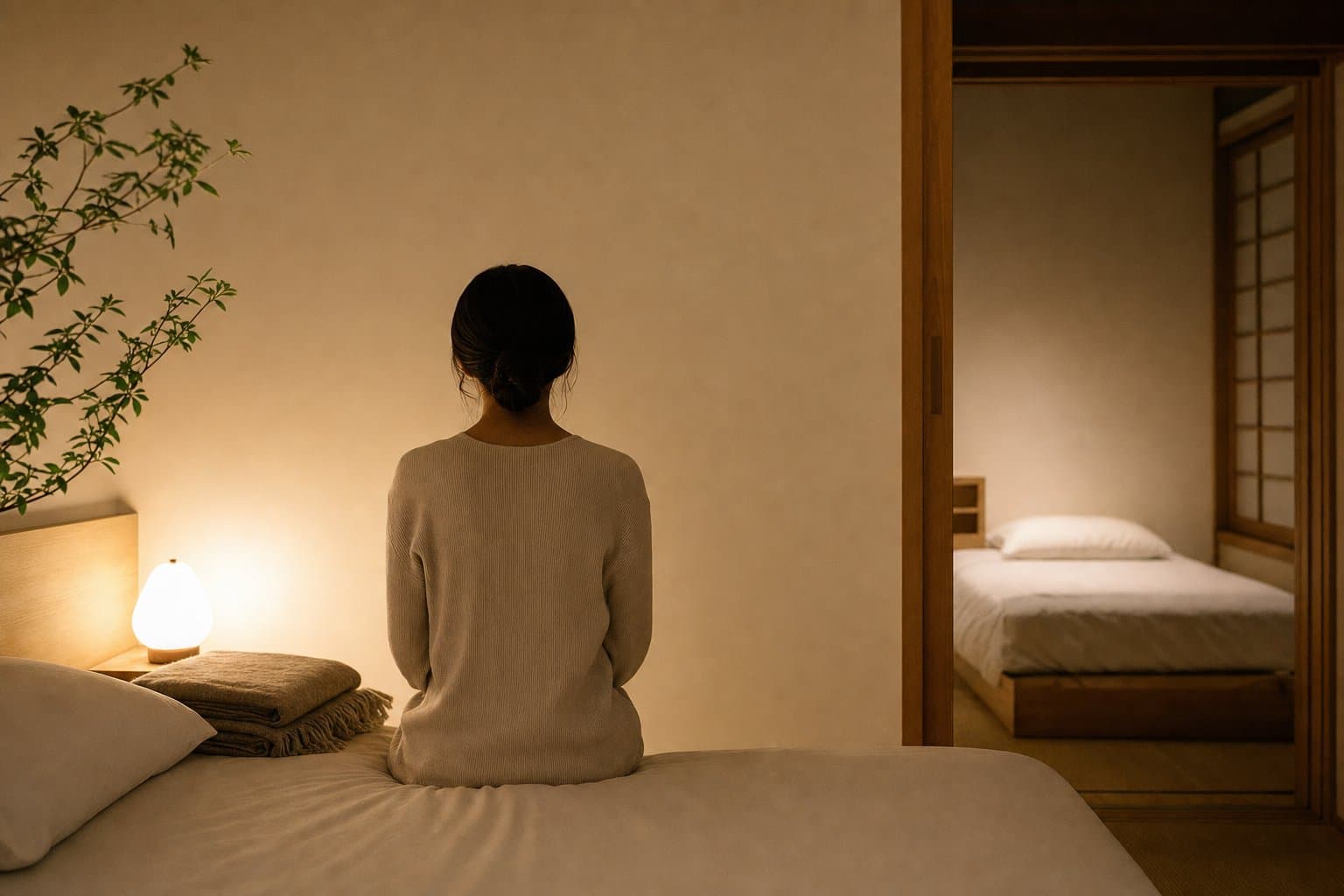
Swap one double for two singles. Independent mattresses absorb snoring vibration and movement, and each person picks their own firmness. On layout, two configurations cover most rooms: set the beds about ten centimeters apart with a small table between them for maximum independence, or push them together with a gap filler so the surface still behaves like one bed.
Choose based on whether you are solving for isolation or for closeness. ③ Separate rooms, part-time. A weeknights-apart, weekends-together hybrid fits Japanese floor plans best, and households with young children can split it by day of the week alongside who handles bedtime. If snoring is the core issue, a pillow designed to encourage side-sleeping sometimes resolves enough of it that a second room never becomes necessary.
Troubleshooting follows the same ladder. No change after tier one? The culprit is sound or vibration, not the duvet — move to tier two. Still waking at night at tier two? Noise is dominant, so go to tier three or address the snoring directly. Still exhausted during the day after tier three? At that point the variable is likely physiological rather than environmental, and a sleep clinic is the right next step rather than more experimentation.
Decide your exit condition too. If the separate room makes one of you genuinely lonely, or conversation drops off, step back down to tier one or two without treating it as failure. The tiers are a dial for finding your fit, not a staircase where higher means better.
The takeaway: an investment in rest, not a split
Sleep divorce is not a step toward breaking up — it is a design choice that protects tomorrow morning's version of both of you. The definition is a rearrangement of beds, not a separation. The goal is restoring the continuity of your sleep. And the path runs in three tiers: separate duvets, separate beds in the same room, then part-time separate rooms.
You do not have to jump to the last one. Start with separate duvets. It is the one change you can make tonight and undo tomorrow if it does not suit you, which makes it about as low-risk as a first step gets. Duvets from Japanese heritage brand Nishikawa and side-sleeping pillows like YOKONE are linked below for comparison.
Often a bedding upgrade solves the problem before a second bedroom is ever on the table. If loneliness is the part you are worried about, agree in advance on thirty minutes together in the same room before lights out — that ritual makes the transition far smoother than improvising it. *This article organizes publicly available information and is editorial, not medical advice. Individual experience varies. For serious sleep disorders, consult a sleep clinic.
FAQ
What does sleep divorce actually mean?
It describes couples who stay together but sleep in separate beds or rooms for the sake of rest. The term is a direct translation of the English phrase and has nothing to do with legal divorce or living apart. It is framed as a practical fix for the interruptions that come from sharing a bed — snoring, restlessness, mismatched bedtimes. Treat it as an adjustment to the sleep environment rather than a signal that a relationship is failing.
How many couples actually sleep in separate rooms?
The American Academy of Sleep Medicine found that more than one in three Americans occasionally or consistently sleep in another room because of a bed partner. We do not have a reliable nationwide figure for Japan to quote here, and would rather say so than guess. What is clear is that major Japanese outlets have covered the topic repeatedly, which makes it harder to describe separate bedrooms as an unusual minority choice.
What if sleeping in separate rooms just feels lonely?
Loneliness is data, not something to override. Agreeing in advance on shared touchpoints — time together in the same room before lights out, breakfast together every morning — makes the transition much easier. If it still feels wrong, step back to two beds in the same room instead of two rooms. There is no prize for enduring an arrangement that makes you unhappy, and how people experience this varies a great deal from couple to couple.
How should we lay out a separate-bed bedroom?
If you are keeping one room, the decision reduces to a single question: are you optimizing for isolation or for closeness? Two singles set slightly apart with a small table between them limit how much movement and noise travel between sleepers. Pushed together with a gap filler, the setup still looks and functions much like a double while keeping the mattresses independent. Let the room's size and walking paths make the final call.
Why did sleep divorce take off in America?
The turning point was actress Cameron Diaz saying on a December 2023 podcast that separate bedrooms should be normalized. CNN reported the remark and the conversation spread quickly from there, later reaching Japanese outlets including National Geographic Japan, PRESIDENT Online, and Nazology. The behavior itself was not new — plenty of people were already doing it quietly. What changed was that it finally had a name people were willing to say out loud.
What if separate rooms still do not fix our sleep?
If you have worked through separate duvets, separate beds, and separate rooms and daytime sleepiness persists, the remaining variable is more likely physiological than environmental. Rather than continuing to adjust the setup on your own, book time with a sleep clinic. The same applies if snoring is extremely loud or if a partner appears to stop breathing during the night — that is a reason to seek professional assessment sooner rather than later.
About this article
This article was written by Lukas Weber (Writer / Sleep & Wellness, Data Verification) of the Tokyo Decoded editorial team, with sources and facts checked by the team. We keep editorial independence from advertisers. See our editorial policy.
Sources
Related
How to Choose a Pillow: Height Guide by Sleep Position
Nearly 60% feel their pillow doesn't fit. A practical guide to height and material by sleep position.
Read more →
A Guide to the World's Life-Optimization Trends: Sleep, Rest, and Owning Less
Sleepmaxxing, Bed Rotting, Underconsumption Core — a single map of the world's trends for a better-designed life. Sleep, rest, and belongings, tuned by data rather than by feel.
Read more →
Sleepmaxxing 101: How the World Stopped Guessing and Started Optimizing Sleep
Sleepmaxxing has topped 80M views on TikTok. Here's the science of optimizing sleep—seen from Japan, where people sleep the least in the developed world.
Read more →