
Money Anxiety Reading List: 5 Books That Actually Help in 2026
Money dysmorphia, revenge saving — five books that turn financial anxiety into knowledge you can use.
 By Mina KiryuEditor-in-Chief / Money & Household Finance·2026.07.31 published·2026.09.06 updated·7 min read·4 sources
If thinking about money makes your chest tighten, you are not alone. Credit Karma found 43% of US Gen Z experience money dysmorphia — a distorted, usually worse-than-reality view of their finances — and Japan has its own version: over-saving driven by pure anxiety. This ranking picks five money books available in Japan and sorts them by the specific anxiety each one dissolves.
Some are true beginner primers you can finish in a weekend; others reframe how you think about retirement money entirely. We organised publicly available information and compared the titles on consistent criteria: which worry they address, who they suit, and how much prior knowledge they assume. The ranking is not ordered by difficulty.
It is ordered by how commonly readers get stuck at each stage — which is why the most systematic primer sits at number one and the most philosophical title sits at number five. The goal is not to find the one correct book. It is to find the book closest to the anxiety you are carrying right now, and to start there.
Reading is the quietest, most repeatable form of self-investment we know. When you finish, the numbers in your bank account may not have moved by a single yen. What changes is the way you look at those numbers — and for most people, that is where every other change begins.
What is money anxiety? The defining money trend of 2025-26
Money anxiety is the persistent sense that you cannot see where your household finances are heading — a feeling that runs largely independent of how much you actually earn or hold. It is not a clinical diagnosis. It is a lived-experience term that surveys and reporting have converged on. Its most striking form is money dysmorphia: a distorted, usually worse-than-reality reading of your own financial position. Credit Karma (2024) found 43% of US Gen Z and 41% of Millennials self-identify with it, which is why the numbers make clear this is not a mood but the defining money trend of 2025-26.
In the US, that anxiety surfaced as restraint. CNBC reported in June 2025 on revenge saving — consumers deliberately shifting money into savings as they braced for economic uncertainty. The personal savings rate rose from 4.1% in January 2025 to 4.9% by April. It is the precise mirror image of the revenge spending that followed the pandemic.
Japan sits differently on the map. Dai-ichi Life Research Institute's October 2024 report, Households that hoard, consumption that won't grow, notes a rebounding household savings rate and sluggish consumption: anxiety layered on top of a culture that already leaned toward saving. Here, not spending becomes the instrument of reassurance — and that reassurance quietly generates the next round of worry, because a balance that only grows never tells you whether it is enough.
Different symptom, same root cause: a lack of visibility. Neither version is solved by earning more, because neither was caused by earning too little. What closes the gap is a framework for interpreting the numbers you already have. Books are how you widen the view, and why a reading list is a reasonable first move rather than a soft one.
Why dissolving money anxiety by reading works in Japan
Japanese households live a strange paradox: they save well, yet feel constantly anxious. J-FLEC's Public Opinion Survey on Household Financial Behavior 2025 shows people with meaningful assets still answering that they are worried about retirement. The problem is not the amount. It is a lack of conviction about how you use your own money.
Why does reading actually work on that? The mechanism is unglamorous: most money anxiety comes from not knowing the order of operations. Save first, or invest first? Is insurance necessary before either? When the sequence is undefined, the mind treats every open question as equally urgent and worries about all of them at once.
A book, unlike a feed, walks from premise to conclusion in a fixed order. By the last page you can locate yourself on that sequence — this stage done, that stage next, this one not yet relevant. Reducing the number of live decisions is what shrinks the anxiety to a workable size. Global trends like loud budgeting and soft saving rest on the same premise: get a language for spending that matches your values. Social feeds amplify unease precisely because they deliver conclusions stripped of their sequence.
One misconception is worth dismantling. Many readers assume money books are for people who already have money — that you should sort out your finances first, then read. It works the other way round. The smaller your capital, the larger the share of your household a single misjudgement occupies, so building the map early is the faster route even when it feels like a detour.
Be realistic about pace, too. Reading does not repair a budget overnight, and results vary considerably from person to person. What reliably changes is naming: once the anxiety has a name and a place in a sequence, it becomes surprisingly manageable. That is the quiet power of a reading prescription.

Best money books for beginners — how to read this list
We organised publicly available information on the standard money books sold in Japan, compared them on consistent criteria, and picked five sorted by the type of anxiety each addresses. You do not need to read them in order — start with the one closest to your current worry. Two weeks per book is a reasonable pace, and reading only the introduction and contents page to extract the overall map is a legitimate outcome in itself.
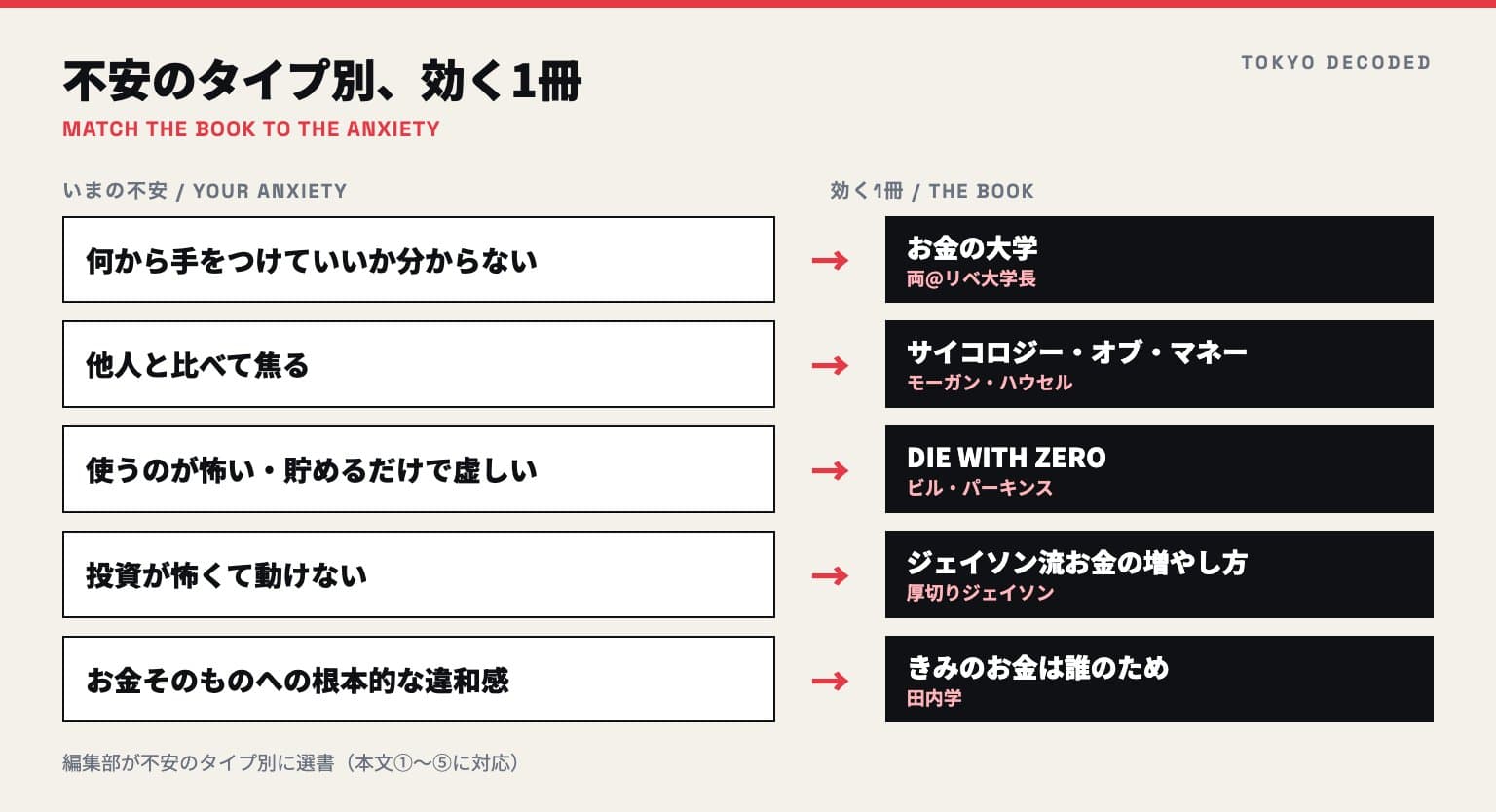
① Okane no Daigaku by Ryo (Liberal Arts University) — for I don't know where to start anxiety. A systematic primer on five money skills: save, earn, grow, protect, spend. The natural first purchase for beginners. Turns your household finances into a single map.
② The Psychology of Money by Morgan Housel — for comparing myself to others anxiety. The classic argument that money is psychology, not math. Best for readers who feel worse after seeing other people's balances and portfolios online, and who want the mechanics of money dysmorphia to click.
③ Die With Zero by Bill Perkins — for scared to spend, hollow to only save anxiety. The single most relevant book for Japan's over-saver profile, and for anyone stuck on how to think about retirement money. Its experiences compound framing is the exact counter-prescription to revenge saving.
④ Jason-ryu Okane no Fuyashikata by Atsugiri Jason — for too scared to invest anxiety. A stripped-down index-investing playbook that removes the jargon and makes the first step small enough to actually take.
⑤ Kimi no Okane wa Dare no Tame by Manabu Tauchi — for a deeper, philosophical unease with money itself. A narrative reframing of what money is for, and the easiest of the five to read if dense nonfiction tires you out.
Troubleshooting: if you have not turned a page in three days, the issue is usually mismatch rather than difficulty — switch to a different number on this list. If reading makes the anxiety worse, pause. And decisions about your specific household or particular financial products should not rest on a book alone; consult a qualified professional. All five are in stock on Rakuten Books with substantial review counts. Compare them via the CTA below.
The takeaway: money anxiety shrinks one book at a time
Left alone, money anxiety tips into revenge saving or extreme frugality, and quietly erodes quality of life. Read one book and the anxiety gets a name — and your options widen. How quickly that translates into changed behaviour varies from person to person, but acquiring an order of operations costs nobody anything.
The first step is small. Write your current worry down in a single sentence, then pick the number on this list that matches it. Lost on where to begin, take
- . Deflated by comparison, take
- . Stuck on how to spend in later life, take
- . Frozen at the thought of investing, take
- . Uneasy with money itself, take
- . Then buy that one book — compare prices and reviews on Rakuten Books via the links below. Buying all five at once is the most reliable way to finish none of them.
Once you have read it, cross-reference it with our full 2026 money trends map to see where your single title sits in the wider picture. Knowledge is the quietest, most reliable investment there is, and it compounds the moment you open the first page.
FAQ
Which money book should a complete beginner read first?
Start with the widest map. This list places
- Okane no Daigaku first for beginners because it lays out save, earn, grow, protect and spend as a single sequence, which leaves you able to judge what to learn next on your own. If investing is the specific thing that scares you, starting at
- is equally valid. Match the book to the worry you actually have rather than following the ranking order.
How should I choose a money book marketed to women?
Choose by the anxiety a book addresses rather than by who it is marketed to. If your concern is income that shifts with life events or changes in how you work, pairing
- (the whole-household map) with
- (how to think about spending) tends to fit well. If comparison is what stings, take
- . Category shelves are a useful entry point, but check the contents page to confirm the book actually speaks to your worry.
I am anxious about money in retirement. Which book helps?
③ Die With Zero is the core recommendation. It centres on when and on what you spend rather than on how much you accumulate, which fits the common Japanese pattern of saving successfully yet feeling unable to spend. For the specifics of pensions and public schemes, do not rely on a book alone — consult a qualified professional. J-FLEC's survey shows people with assets still worried about retirement, which confirms this is a visibility problem, not an amount problem.
Will reading a book make my money anxiety go away?
No one can promise that it will. Results vary from person to person, and a book is a tool for making anxiety manageable rather than removing it. What typically shifts is the number of things you worry about at once, because a clear order of operations narrows the field. If reading intensifies the unease, pause, and speak to a qualified professional if you need to. Never decide a specific household question or financial product on the strength of one book.
How many money books should I actually read?
One is enough to begin with. The five here are sorted by anxiety type specifically so they do not overlap, which means you gain little by stacking similar titles. Two weeks per book is a workable pace, and reading only the introduction and contents page still gives you the map. Buying several at once is the most common route to finishing none, so decide on the next title only after seeing which worry remains once the first is done.
About this article
This article was written by Mina Kiryu (Editor-in-Chief / Money & Household Finance) of the Tokyo Decoded editorial team, with sources and facts checked by the team. We keep editorial independence from advertisers. See our editorial policy.
Sources
- CNBC, “Nearly half of young adults have 'money dysmorphia,' survey finds” (Mar 13, 2024) — CNBC
- CNBC, “'Revenge saving' picks up as consumers brace for economic uncertainty” (Jun 27, 2025) — CNBC
- Dai-ichi Life Research Institute, “Households that hoard, consumption that won't grow” (Oct 11, 2024, Japanese) — 第一生命経済研究所
- Japan Financial Literacy and Education Corporation (J-FLEC), “Public Opinion Survey on Household Financial Behavior 2025” (Japanese) — J-FLEC
Related

The 2026 Guide to Global Money Trends: From Loud Budgeting to Cash Stuffing
Loud Budgeting, Soft Saving, Cash Stuffing — a single map of the money trends born overseas. Which one fits you, and how to actually practice it in Japan.
Read more →
Kakeibo App Comparison: 4 Money Apps to Quiet Financial Anxiety
Comparing 4 kakeibo apps by the anxiety they solve: Money Forward ME, Zaim, OsidOri, Moneytree.
Read more →
Revenge Saving: The New Money Habit Pushing US Savings Rate to 4.9%
The anti-splurge movement sweeping the US in 2025, and why Japan was ready for it all along.
Read more →