
Sinking Funds: The FinTok Method for Predictable Surprises
Car inspections, holidays, birthdays — build monthly savings for predictable irregular expenses.
 By Mina KiryuEditor-in-Chief / Money & Household Finance·2026.07.29 published·2026.09.07 updated·7 min read·2 sources
Broke again this month — car inspection got me. It is the expense you knew was coming, yet somehow it still lands like an ambush. Car inspections, property tax, the bullet-train tickets home at New Year, school entrance costs, year-end gifts and New Year money for the kids. Every one of them is visible on a calendar months in advance.
None of them appear in a normal monthly budget. So the bill arrives, the month goes red, you promise yourself you will plan better, and twelve months later the exact same surprise repeats. Sinking funds are the FinTok-favorite answer to that loop: estimate what an irregular expense costs per year, divide it across the months, and set the money aside before the bill exists.
It is unglamorous and it is slow, which is precisely why it works. And if the term sounds foreign, the practice will not be. Japanese households have done this for decades under the name tokubetsu-hi tsumitate, or special-expense savings, often with physical envelopes. What follows is the global playbook translated into a system that fits Japanese life: what special expenses actually are, how to list them, how to decide how much to set aside, and how to record the whole thing in a household ledger without it collapsing by March.
What are sinking funds? Special expenses, defined
A sinking fund is a pot of money you build up in advance for an expense you can predict but do not pay monthly. In Japanese household budgeting the same category is called tokubetsu-hi, or special expenses: car inspections, property and residence tax, travel home for the holidays, weddings and funerals, annual insurance premiums, yearly subscription renewals, school fees. They are guaranteed to arrive and they are entirely absent from a normal monthly budget, which is exactly why they feel like emergencies when they land.
In English-speaking finance communities the account or category itself is called the sinking fund, and most people run several at once, one per purpose.
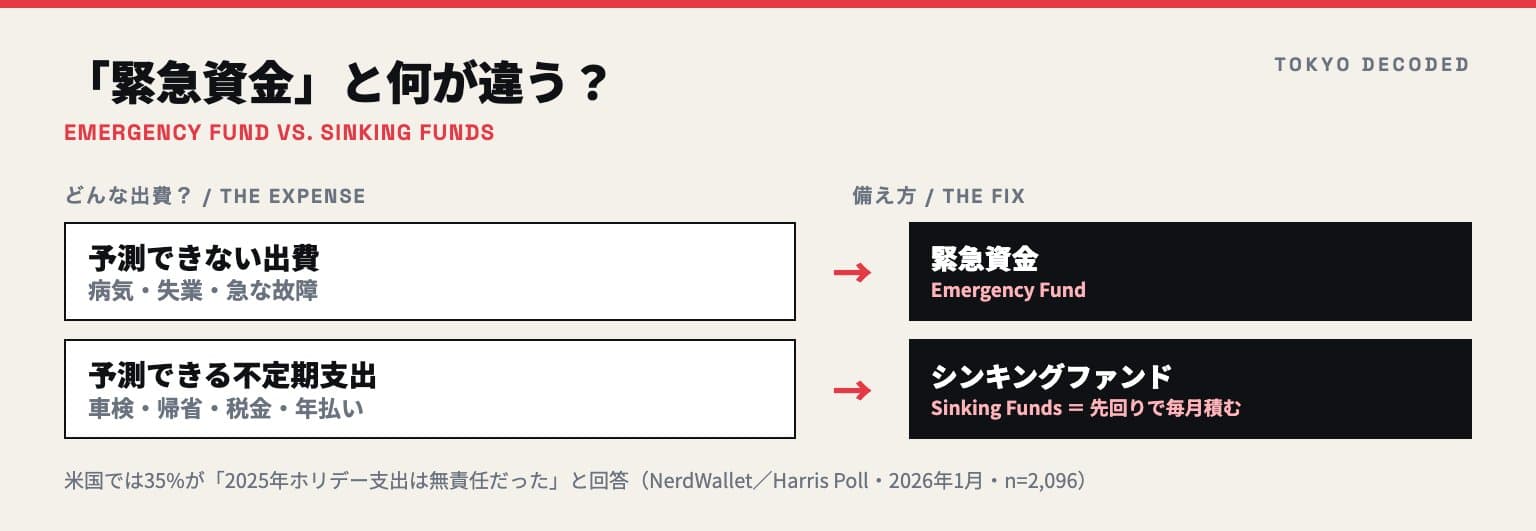
The reason the idea keeps trending is that predictable spending is what actually breaks budgets. A January 2026 Harris Poll conducted for NerdWallet (n=2,096) found 35% of Americans described their 2025 holiday spending as financially irresponsible. Among those who put their 2024 holiday costs on credit cards, 31% still had not cleared the balance nearly a year later.
The date of the holidays is not a mystery to anyone; the planning is what was missing. Bankrate's 2025 Emergency Savings Report adds the other half of the picture: only 41% of Americans said they could cover a $1,000 emergency from savings. When thin reserves meet unplanned but foreseeable bills, ordinary expenses get financed with debt. Ramsey-affiliated creators such as Rachel Cruze keep returning to sinking funds because this is where the leak is.
Search for the term in Japanese and you still mostly find the corporate-finance translation, a debt redemption fund. But in a household context the practice sits directly alongside Japan's long-standing cash stuffing tradition — separate the money by purpose, then leave it alone until the month it is needed. You are not importing a foreign technique. You are giving an expense category you already have a name, a home, and a monthly deposit.
Why it works: sinking funds vs. emergency funds
The mechanism becomes clear once you separate sinking funds from emergency funds. An emergency fund covers the genuinely unpredictable: job loss, a medical shock, a refrigerator dying overnight. You cannot know the amount or the timing, so it lives as one undifferentiated pile. A sinking fund covers the predictable-but-irregular. Car inspections come every two years in Japan. Property tax arrives the same month annually. School entrance costs are scheduled by your child's age. When you know roughly when and roughly how much, you can prepare differently — and you should.
The separation works because it removes decisions. If everything sits in one savings balance, every irregular bill triggers the same internal argument about whether this money is allowed to be spent. Most people resolve it by raiding the emergency fund and then forgetting to refill it. With purpose-based pots, the car inspection month simply draws from the car inspection pot. No deliberation, no guilt. The corollary matters too: sinking funds usually fail not when the balance runs short, but when the boundaries between pots go soft.
One misconception worth killing. People often count their special-expense savings as part of their savings rate, since the money is technically in the bank. It is not savings. It is deferred spending with a recipient already assigned. Mixing the two makes a budget look healthier than it is, and produces the demoralizing moment when a balance that had been climbing all year collapses in a single inspection month. In your ledger, keep special-expense deposits on a separate line from genuine saving and investing.
This matters especially in Japan because spending here is strongly seasonal. April brings the new school and fiscal year. August and the New Year bring travel home. Vehicle tax, property tax, and ceremonial occasions land on a near-fixed calendar. Build the annual map once and it largely holds for the following year. Japanese kakeibo culture has done this for decades as tokubetsu-hi. FinTok gave the same practice a systematized English name and a wave of dedicated apps — but the envelope method got there first.
How to start: listing items and setting amounts
① Audit the calendar. Open twelve months of bank and credit card statements and list every expense that did not occur monthly. Common special-expense line items in Japan: car inspection, vehicle tax and car insurance, property tax, residence tax paid by voucher, travel home for holidays, vacations, weddings and funerals, family birthdays and Christmas, New Year money for children, mid-year and year-end gifts, school entrance and grade-change costs, annual life and casualty insurance premiums, yearly subscription renewals, replacement funds for appliances and phones, and routine dental or medical care.
② Estimate the annual cost of each. Use last year's actual figure where you have one, and round generously where you do not. A surplus is recoverable; a shortfall becomes credit card debt.
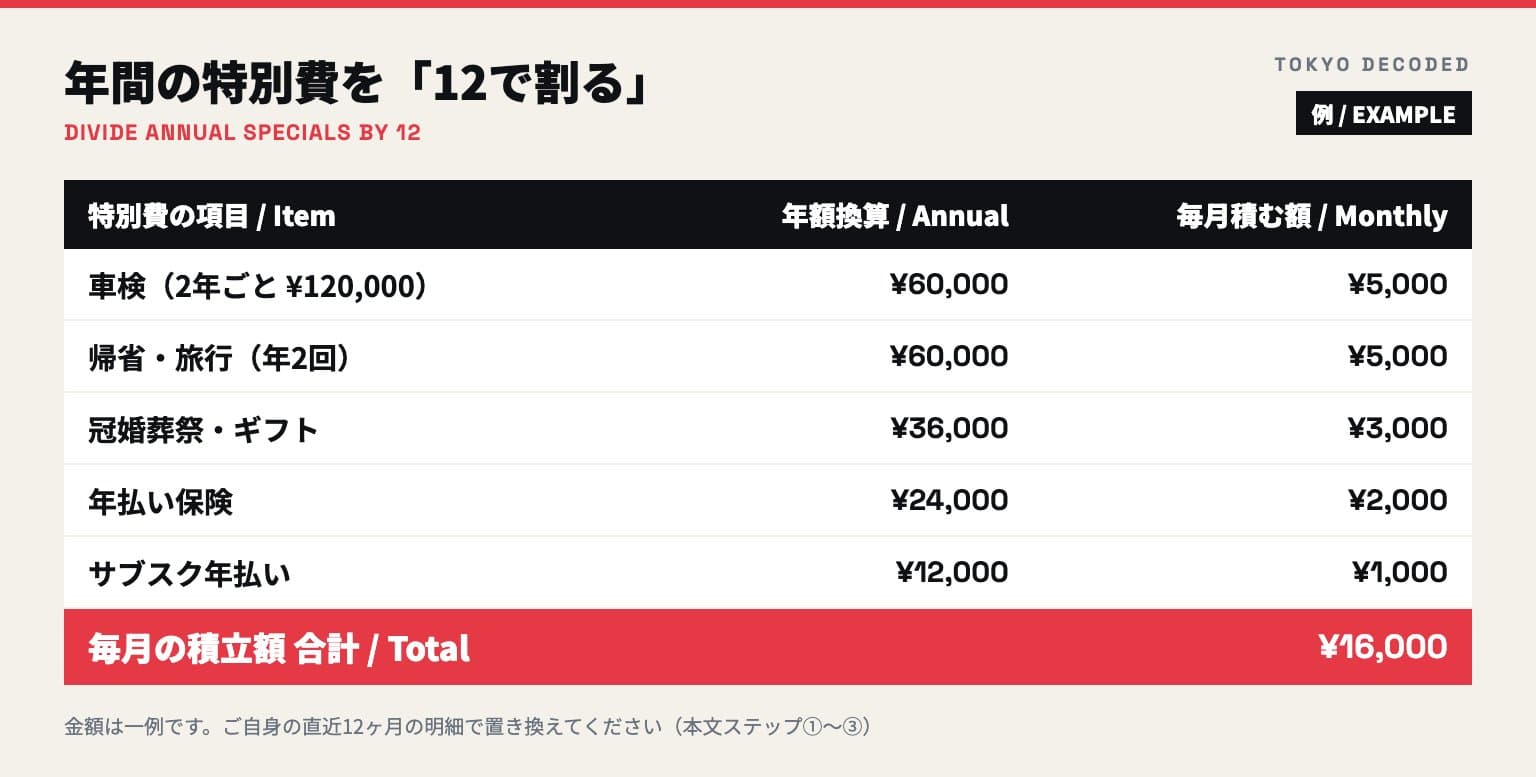
③ Divide to get the monthly deposit. For a car inspection you are spreading across two years, divide the total by 24. For anything annual, divide by 12. This is where the how much question gets answered — and the honest answer is that the right number is not somebody else's average, it is the sum of your own list. If that total does not fit your take-home pay, do not shave every line down proportionally. Rank instead: protect the unavoidable items like inspections and taxes first, and let discretionary ones like travel and gifts absorb the cut.
④ Decide how to record it, then automate. In your ledger, book the monthly deposit as an expense line every month, and when the bill actually arrives, draw it from the accumulated balance rather than from that month's spending. That two-step keeps a car inspection from making an otherwise normal month look catastrophic.
From our review of publicly available information compared on consistent criteria, Money Forward ME auto-syncs multiple accounts and supports purpose tags that approximate envelopes, while Zaim allows custom categories that suit special-expense labels. Rakuten Bank's purpose-based sub-accounts separate the money at the account level.
⑤ Diagnose failure. Running a deficit every month means the deposit exceeds what your budget can carry. A balance that quietly shrinks means the pots are leaking into each other. Too many categories to track means starting over with only your three largest. Results vary by household, so plan to review the whole map every three months.
The takeaway: shrink the annual surprise
Car inspections, trips home, tax bills, New Year envelopes — they are all coming next year, guaranteed. Sinking funds simply stop you being startled by them, by moving each one into your monthly budget before it arrives. There is no clever technique involved. The whole method is elementary-school arithmetic, dividing an annual number by twelve, plus one honest line in your ledger.
For a first step, do not try to build the perfect list today. Pick a single non-monthly expense from your recent statements, estimate what it will cost over the coming year, divide by twelve, and add that figure as a line in next month's budget. That is enough to start. You can add categories as you remember them, and your first-year estimates being wrong is normal rather than a sign the system failed.
Once you are running three or four pots, move to automation with a categorized budgeting app or purpose-based bank sub-accounts. Our kakeibo-app comparison above breaks down which app fits which anxiety. Tokyo Decoded's Digital Kakebo worksheet is also free if you would rather sketch your annual special-expense map on paper before committing it to an app.
FAQ
What exactly counts as a special expense?
Any expense that does not recur monthly but that you know will arrive eventually. Typical examples include car inspections, vehicle and property tax, holiday travel, weddings and funerals, gifts and New Year money for children, school entrance costs, and annual insurance or subscription renewals. If you are unsure, ask whether the expense skipped some months last year and is likely to return next year. Monthly items belong in living costs; genuinely unpredictable ones belong to your emergency fund.
How much should I set aside each month?
Work backwards from your own list rather than copying an average. Write an estimated annual cost next to each item, divide yearly items by twelve and two-year items like car inspections by twenty-four, then add the results together. That sum is your monthly figure. If it does not fit your budget, avoid trimming every line equally — protect unavoidable items such as taxes and inspections, and take the reduction from discretionary categories like travel and gifts. Circumstances vary by household.
How do I record special expenses in a household ledger?
A two-step record is the clearest approach. Each month, book your chosen deposit as an expense line labelled special-expense savings. Then, in the month a real bill lands, draw it against that accumulated balance rather than against that month's living costs. This keeps one inspection or one trip from making an otherwise ordinary month look disastrous, and makes month-to-month comparison meaningful again. Keep this line separate from genuine saving and investing so your savings rate stays honest.
Should sinking funds be separate from an emergency fund?
Keeping them apart makes both work better. An emergency fund exists for genuinely unpredictable events like job loss or sudden illness, where neither timing nor amount can be forecast. A sinking fund holds money for expenses whose timing and rough size you already know. Combine them and every car inspection quietly drains the emergency reserve, which then goes unrefilled before the next real surprise. You do not need separate banks — purpose-based sub-accounts or clearly labelled app categories are enough, as long as the boundaries stay firm.
I have too many categories and cannot keep it up. What should I do?
Trying to manage every line from day one is the usual failure mode. Start with only your three largest items — typically things like car inspections, holiday travel, and tax bills, where an unplanned hit does the most damage. If a balance shrinks without you noticing, that is a sign the pots are leaking into one another, so tighten the boundaries with purpose-based sub-accounts or clearly named app categories. Planning to review the whole setup every three months makes the habit far easier to sustain.
About this article
This article was written by Mina Kiryu (Editor-in-Chief / Money & Household Finance) of the Tokyo Decoded editorial team, with sources and facts checked by the team. We keep editorial independence from advertisers. See our editorial policy.
Sources
Related

The 2026 Guide to Global Money Trends: From Loud Budgeting to Cash Stuffing
Loud Budgeting, Soft Saving, Cash Stuffing — a single map of the money trends born overseas. Which one fits you, and how to actually practice it in Japan.
Read more →
What Is Moneymaxxing? Optimizing Options, Not Just Balances
Moneymaxxing isn't about growing the number. It's about widening the options your existing money can buy.
Read more →
Pay Yourself First: Automate Your Savings Before You Spend
Failing to save isn't willpower—it's sequencing. Build an automatic system that moves money on payday.
Read more →