
No-Buy 2026 Mid-Year Reset: Rebuild Your Challenge with Systems, Not Willpower
Failed your No-Buy year? July is the reset point. 44% of Americans are trying it—here's how to rebuild.
 By Marcus BennettPhotographer / US Trends, English Edition Editor·2026.07.27 published·2026.09.07 updated·7 min read·2 sources
This is the year I stop buying. Sound familiar? If you made that vow in January and now, opening your statement in July, you are wondering where it all went wrong, you are not alone. Half a year in, many No-Buy 2026 participants hit a wall: a sale purchase here, a midnight impulse click there, small convenience-store indulgences that quietly add up.
But here is the reframe happening across US YouTube right now: mid year no buy update videos have become a whole genre, and the consensus is that failure is not failure, it is a signal that your rules need redesigning. A no-buy year was never a contest of endurance. It is a time-boxed experiment designed to make your buying decisions visible to you, which means stumbling mid-way does not end the experiment; rewriting the rules continues it.
July is the halfway point. Reset your system now, and the next six months can genuinely feel lighter than the first. This guide starts from the basics of what a no-buy challenge actually is, moves through category-specific versions such as a clothing no-buy and a cosmetics no-buy, and ends with a concrete rebuild sequence for anyone who has already slipped. Everything here is organized from publicly available reporting, and it is built so that you finish with one step you can take today.
What Is a No-Buy Challenge? The Basics and the Boom
A no-buy challenge is a time-boxed experiment in which you commit to buying nothing beyond essentials for a set period. The crucial detail, and the one most newcomers get wrong, is that it does not mean spending zero. Food, rent, transport, medication and household basics keep flowing as normal; what stops is discretionary buying — the clothes, gadgets, cosmetics, decor and impulse purchases you choose rather than need. Periods range from a single month to a full twelve, with a full year usually called a no-buy year and the softer version, where you simply buy less, called low-buy.
The scale of the movement is social. TikTok's #nobuychallenge has racked up roughly 4.9 million posts, and Reddit's r/nobuy community passed 70,000 members as of July 2026 (Yahoo Finance, July 3, 2026). An Intuit Credit Karma survey cited by Entrepreneur (June 16, 2025) found 44% of Americans are doing or planning a low-buy year and 42% a full no-buy year. The driver is a quiet revolt against inflation and the hollowness of buying more and feeling less.
In Japan, personal bloggers and note.com writers have been documenting kawanai chosen, the not-buying challenge, since 2025, and searches often carry a year attached — people look for the 2025 edition or the 2026 edition as if it were an annual event, which is exactly how the culture behaves. Each January the challenge resets and a new cohort starts. That framing matters for anyone reading this in the middle of a year: the calendar is a convention, not a rule.
Japan also brings its own foundation to the idea through mottainai, the ethic of not letting things go to waste, alongside Underconsumption Core and the deinfluencing movement. Seen that way, no-buy is less an imported trend than a name for something Japanese households have practiced for generations.
Why July Breaks You: The Flaw in Willpower-Based No-Buy
People who quit at the six-month mark do not have weak willpower. They have three design flaws in their rules. First, the rules are too extreme: a total buy-ban is not humanly sustainable, and the moment it breaks the whole year feels void. Second, the exception list is fuzzy. What about cosmetics? A friend's wedding gift? School supplies for a child? Deciding from scratch every time drains the exact mental energy the challenge depends on. Third, there is no logging system, so the good days leave no trace and wins stay invisible. The US no-buy community calls this the black-and-white trap.
One misconception is worth killing outright: the belief that a no-buy year means spending nothing at all. It does not. Essentials continue by design, and only discretionary purchases stop. That is precisely what makes a twelve-month version survivable. Cutting into groceries or health spending tends to backfire, showing up later as a rebound splurge.
Why do systems outperform resolve? Because impulse buying is a distance problem. The gap between feeling a want and completing a payment has collapsed to a few taps on a phone. Insert friction — a waiting period, a written log — and you buy yourself enough time for the peak of wanting to pass. Slowing the decision is far more reproducible than tightening the ban.
Japan's own kakeibo tradition, the household ledger born in 1904, fits this logic naturally. It was never primarily about cutting costs; it was a tool for reviewing your month in dialogue with yourself. Observation, not deprivation. Reframe no-buy the same way: not resisting purchases but making buying decisions conscious.
Whether it is the public accountability of Loud Budgeting or the controlled rebound of revenge saving, the people who succeed run on systems, not grit. Results and sustainability vary from person to person, and anyone under genuine financial strain should seek qualified advice rather than tighten the rules further.
How to Reset a No-Buy: A 5-Step Mid-Year Rebuild
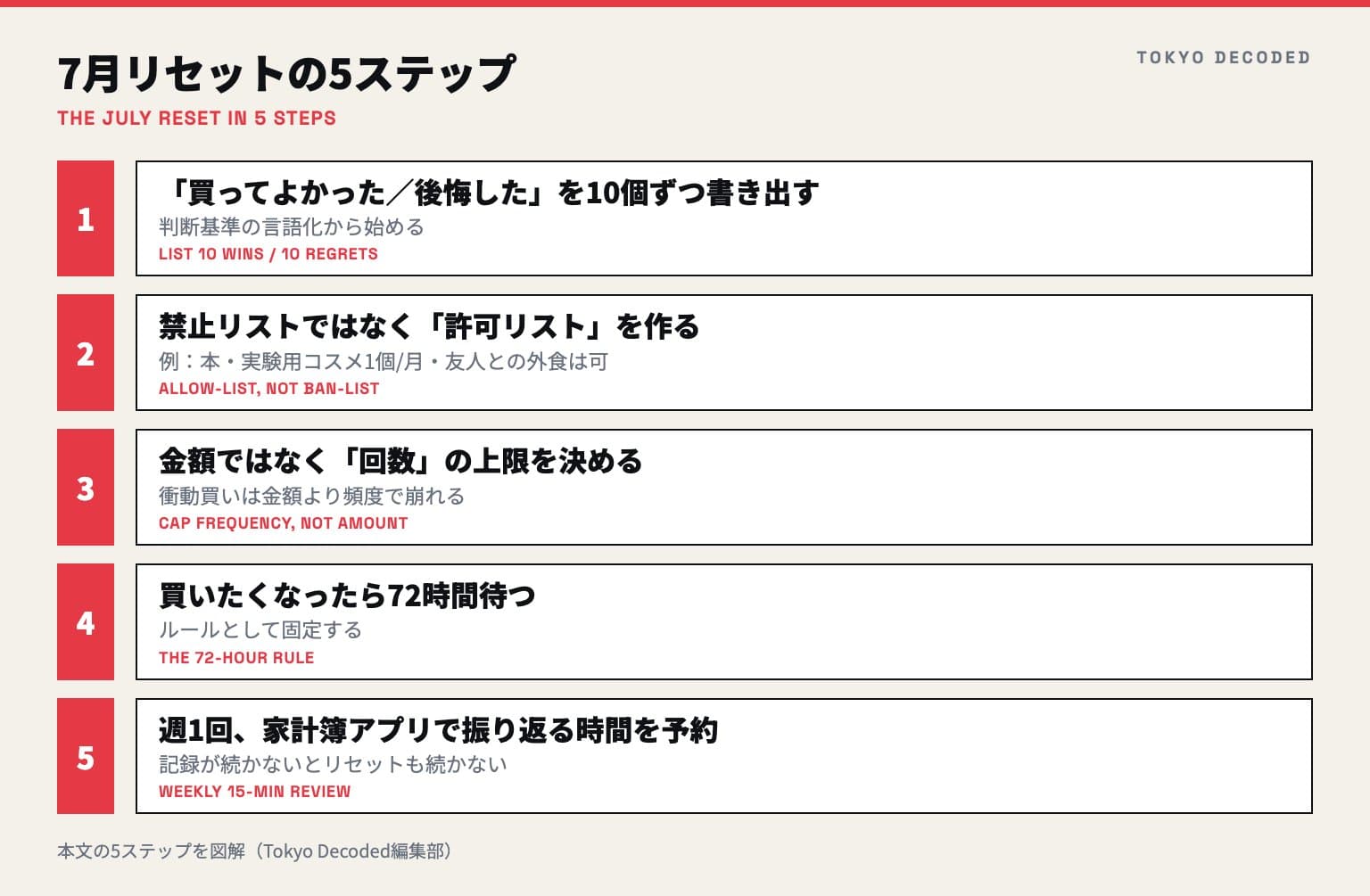
A July reset works best as five steps.
- Write down 10 purchases you are glad you made and 10 you regret from the first half of the year. This verbalizes your criteria, and if one category dominates the regret column, that category is your real battleground for the next six months.
- Replace the ban list with a permission list: books are fine, one experimental cosmetic per month is fine, meals with friends are fine. Deciding what is allowed in advance is far faster than adjudicating each temptation.
- Set a frequency cap rather than a spending cap.
Impulse buying breaks down by frequency more than by amount, so a limit of how many times per month holds better than a yen figure.
- Install a 72-hour waiting rule for anything you want. Write the reason in a note while you wait, and let yourself buy it if the want survives the deadline — permission on the far side removes the guilt spiral.
- Book a weekly 15-minute review in your calendar. This is the hinge; without logging, resets do not stick.
Decide your category rules too. For a clothing no-buy, count what you already own and pre-approve replacements for worn-out socks and underwear so the rule does not collide with basic upkeep. For a cosmetics no-buy, the most sustainable version is a use-it-up rule: no new purchases in a category until the opened product is finished, with sunscreen and anything medicinal kept as standing exceptions. Do not white-knuckle decisions that affect your skin or health; consult a professional where relevant.
Troubleshooting is simple. Breaking the rules often means the rules are too strict. Feeling miserable while keeping them means you have no log and therefore no visible wins. Being unable to recall what you bought means the tracking tool is wrong for you. If the same failure repeats for three straight weeks, change the design rather than your resolve.
On tools, organizing publicly available information on free budgeting apps in Japan under consistent criteria, three names recur among practitioners: Money Forward ME for receipt scanning plus bank sync, Zaim for simplicity that people keep up with, and OsidOri for couples and family sharing — see our budgeting app comparison. For the deeper why-do-I-buy work, Bill Perkins' Die With Zero and Elizabeth Dunn's Happy Money help decouple spending from happiness.
The Takeaway: No-Buy Runs on Systems, Not Willpower
If July has you thinking maybe I cannot do this, that is not failure — that is a design signal. A no-buy year was never a record of endurance; it is an experiment in making your buying decisions conscious. What keeps No-Buy 2026 alive for the remaining six months is therefore not a tighter ban but a logging system you will actually keep.
Your first step today can be small. Install one budgeting app and block 15 minutes in your calendar this week. That alone makes the next temptation easier to judge, because you will have somewhere to put the decision. Our kakeibo-app comparison above covers how to choose. For the categories that trip you up most, clothing and cosmetics being the usual suspects, add a single line to your permission list rather than a new prohibition.
For the deeper reset, Die With Zero by Bill Perkins is the book no-buy practitioners keep recommending in mid-year update videos, and the links below have details and reviews. Outcomes vary from person to person, but make one July week your system rebuild week and the back half of the year looks different.
FAQ
What does no-buy actually mean?
It is a time-boxed experiment where you commit to buying nothing beyond essentials. It does not mean spending zero: rent, food, transport and household basics continue as normal, while discretionary purchases such as clothes, decor and gadgets stop. Periods run from one month to a full year, and the softer variant, where you simply buy less rather than nothing, is called low-buy. Which version suits you depends on your circumstances.
How long should a first no-buy challenge be?
For a first attempt, one to three months is generally easier to handle than a full year. A short window lets you test whether your permission list is accurate, and a design that works can simply be extended. Jumping straight to twelve months tends to expose fuzzy exceptions around the six-month mark. Run one month, look at how often you broke the rules and whether you kept logging, then extend from there.
How do I set rules for a clothing no-buy?
Start by counting what you already own so you know what is genuinely missing versus merely tempting. Then pre-approve upkeep replacements — worn-out socks and underwear, work shoes that have given out — as standing exceptions, because a rule that collides with basic maintenance rarely survives. Finally, turn off sale notifications and clear out saved wishlists. Reducing the number of decisions matters more than tightening the prohibition itself.
Will a cosmetics no-buy affect my skin?
The most sustainable version is a use-it-up rule: no new purchase in a category until the opened product is finished. Keep sunscreen and anything you use to manage a skin problem as standing exceptions, though. Reactions and needs vary from person to person, and enduring a flare-up to protect a spending rule defeats the purpose. If you notice symptoms that concern you, stop improvising and consult a dermatologist or another qualified professional.
I failed my 2025 no-buy. What should change in 2026?
Do not restart with the same rules. Look first at where last year broke down. If the slips cluster in one category, convert that category from a ban into a frequency cap — allowed a set number of times per month — which holds far better than prohibition. Then make logging structural by booking a weekly 15-minute review in your calendar. The strength of this culture is that it resets annually, and you can redesign mid-year rather than waiting for January.
How many people are actually doing this?
An Intuit Credit Karma survey found 44% of Americans are doing or planning a low-buy year and 42% a full no-buy year. On social platforms the scale is similar: TikTok's #nobuychallenge has around 4.9 million posts and Reddit's r/nobuy passed 70,000 members as of July 2026. There is no comparable nationwide survey for Japan that we could locate, but first-person accounts on note.com and personal blogs have grown steadily since 2025.
About this article
This article was written by Marcus Bennett (Photographer / US Trends, English Edition Editor) of the Tokyo Decoded editorial team, with sources and facts checked by the team. We keep editorial independence from advertisers. See our editorial policy.
Sources
Related

Loud Budgeting: The US Trend Changing How We Talk About Money
Loud Budgeting has topped 140M views on TikTok. The new flex is saying 'I'm saving' out loud. Here's the data behind it—and how to practice it from Japan.
Read more →
The 2026 Guide to Global Money Trends: From Loud Budgeting to Cash Stuffing
Loud Budgeting, Soft Saving, Cash Stuffing — a single map of the money trends born overseas. Which one fits you, and how to actually practice it in Japan.
Read more →
Soft Saving: Why 73% of Gen Z Prioritize Today Over Retirement
73% of US Gen Z say today's quality of life beats retirement savings, per Intuit. Meet Soft Saving—frugality that doesn't sacrifice you—seen through Japan's saving traditions.
Read more →