
Pay Yourself First: Automate Your Savings Before You Spend
Failing to save isn't willpower—it's sequencing. Build an automatic system that moves money on payday.
 By Mina KiryuEditor-in-Chief / Money & Household Finance·2026.09.04 published·2026.09.06 updated·7 min read·3 sources
You promise yourself you'll save this month, payday arrives, and by month-end the balance somehow tells a different story. That's not weak willpower—it's the wrong sequence. If you try to save what's left after spending, almost nothing is left, because everyday spending quietly expands to fill whatever sits in the account.
The long-standing global habit called 'pay yourself first' flips the order: the moment your salary lands, a portion moves automatically into a future-you account, and you live on what remains. Change the sequence, and saving stops requiring daily discipline. Better still, once the transfer is scheduled, the number of decisions you make each month drops to zero—no more monthly negotiation with yourself about how much you can spare.
This piece walks through the whole setup for readers in Japan: what paying yourself first actually means, how much to start with and what share of income makes sense, the downsides people rarely mention, and the three-step routine that makes the money move on its own the day after payday. If saving has failed for you before, this is the version that tends to stick.
What is paying yourself first? A definition, and why now
Paying yourself first means moving a set amount into a savings account the moment your salary arrives, then living on what remains for the rest of the month. The key is the reversal: not save what's left, but spend what's left after saving. That single change makes your monthly savings independent of mood, motivation, or how the month happens to go.
Treat it as the plain-language definition of the global habit known as 'pay yourself first'. For context on why this matters now: the Bank of Japan's flow-of-funds statistics for Oct–Dec 2025, as analyzed by the Dai-ichi Life Research Institute, show Japanese household financial assets reaching a record high. Nikkei likewise reported household financial assets hitting a record at the end of 2025, lifted by rising equity prices.
At the same time, the share held as cash and deposits has continued its slow decline. Total household wealth is growing, in other words, but the form it takes is quietly shifting. The Japan Financial Literacy and Education Corporation (J-FLEC) tracks these behaviors annually in its Public Opinion Survey on Household Financial Behavior 2025.
What sits behind the headline figures is an uneven distribution of progress. Two households with identical incomes can end up with very different balances a few years out, depending on whether the saving happens through an automatic system or through repeated acts of willpower. Systems don't get tired; intentions do.
Paying yourself first is the base layer that closes that gap. Before you get into investing, product selection, or optimizing returns, the more durable first move is simply establishing one fixed amount that reliably leaves your spending account every single month. It looks unglamorous, and it is the shortest path.
Why it works: payday culture, and one common misconception
Why does this work? The mechanism is structural, not psychological. People read their account balance and unconsciously decide how much is available to spend. A fat balance loosens spending; a thin one tightens it. That reaction happens more or less regardless of discipline. Paying yourself first rewrites the input to that judgment.
Once the savings portion has physically left for another account, the balance in your spending account simply is this month's budget. You get a spending ceiling without tracking a single receipt. Japan adds a condition that suits this unusually well: an exceptionally consistent payday culture, where salaries land in a bank account on the same date every month.
If payday is the 25th, it is the 25th. That predictability means one scheduled transfer on the business day after payday reduces the required decisions to zero. The reason 'pay yourself first' became a global staple is exactly this rewriting of the order—salary, then bills, then whatever's left, becomes salary, then savings, then live on the rest.
One misconception is worth dismantling here: the idea that you should wait until you earn more before starting. In practice the opposite holds. What matters is less the size of the amount than whether a mechanism exists at all. A small transfer that runs automatically can be dialed up the moment your income rises.
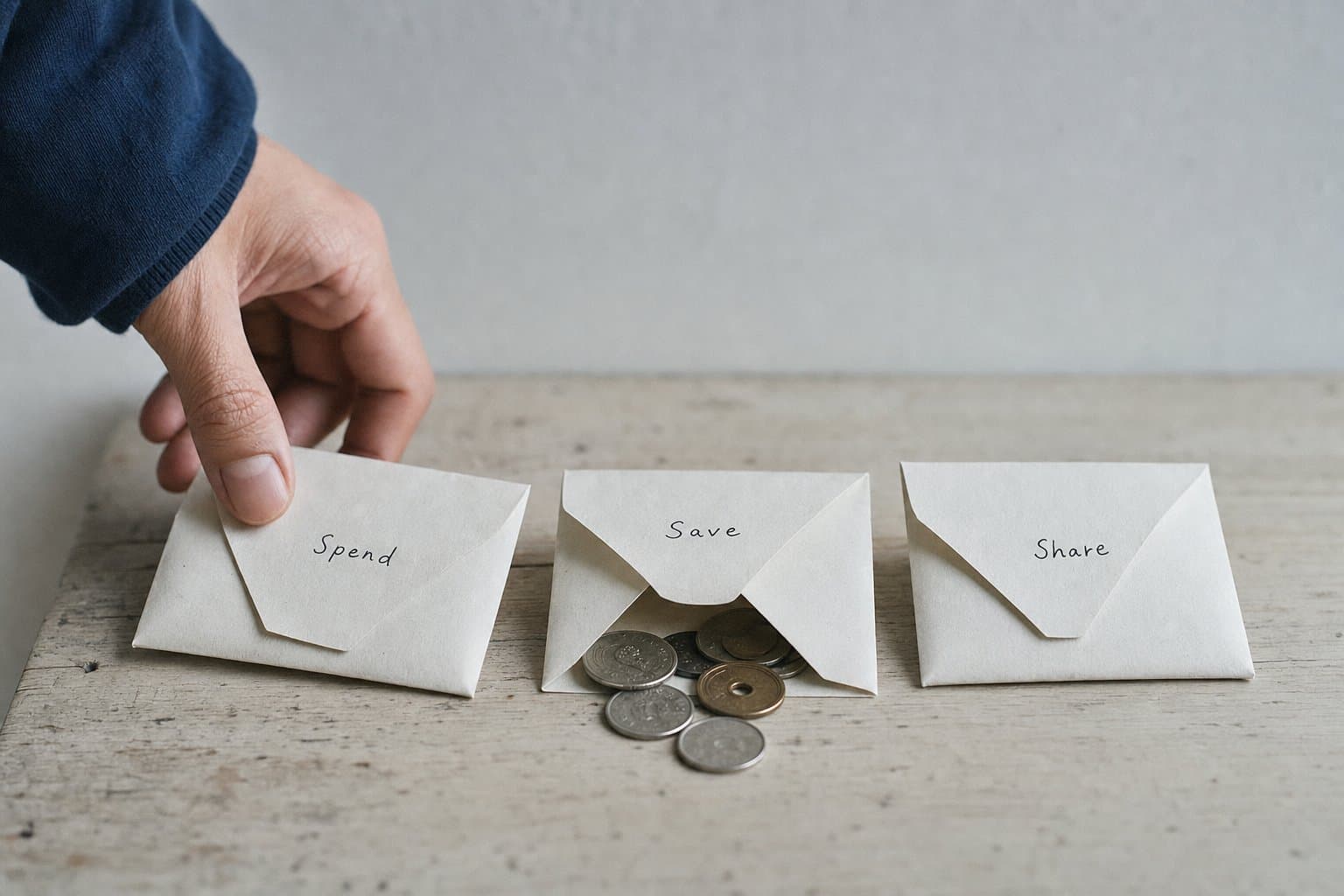
Income that rises without a mechanism in place usually gets absorbed by spending that rises alongside it. The right time to begin is not a salary threshold—it is your next payday. Related ideas in the Japanese context include visualizing spending through household budgeting apps, envelope-style sinking funds for goals, and the gentler philosophy of soft saving. Pay yourself first sits underneath all of them as the base layer—automate this first, then stack goal-based saving on top.

How to start: how much, which buckets, and the automation
①Pick a share you can live with: aim for roughly 10–20% of take-home pay, but start lower if that feels tight. Many people quit after a month when they set 20% too soon. Begin at 5–10%, sustain it for three months, then raise the dial. There is no single correct number—the right figure shifts with rent burden, how much of your pay arrives as bonus, and how steady your income is.
If your income varies month to month, size the transfer against your leanest month rather than your average one.
- Decide the categories: rather than pooling everything into one anonymous balance, splitting the transfer by purpose makes it easier to sustain. Three common buckets are an emergency cushion for unexpected costs, a fund for irregular expenses like appliance replacement or travel home, and general future savings with no assigned purpose yet. Starting with the emergency cushion alone is perfectly reasonable; add the others once a few months of living costs are in place.
- Separate your accounts: keep a spending account and a saving account at different banks.
Within one account, any balance feels spendable. Moving savings out of sight makes them harder to touch. Online banks in Japan make this easy—Sumishin SBI Net Bank's purpose-based sub-accounts, Rakuten Bank, and Aozora Bank BANK Branch all support goal separation and scheduled transfers. ④Schedule an automatic transfer for the business day after payday: use your bank's standing transfer service to move a fixed amount from spending to saving every month.
Most online banks offer this free. The day-after timing lets the salary deposit post fully and avoids transfers that misfire over weekends and holidays. ⑤Troubleshoot when it slips: if you pull money back out of savings at month-end two months running, that is not a discipline failure—it is a signal the amount is set too high. Lower the share and keep the mechanism alive rather than abandoning it.
If money consistently piles up unused, raise it a notch. And if a card payment clears right after payday, place the transfer date after that debit to avoid empty transfers. Once it is set, don't touch it. A budgeting app like Money Forward ME or Zaim is enough to glance at the balance once a month.

The takeaway: it is just a change of order
If saving keeps failing, the sequence—not the willpower—is the problem. Set the automatic payday system once, and next month runs itself. Start at 5–10% of take-home, decide your buckets, separate the accounts, and schedule the transfer for the business day after payday. That's the base layer, done.
As a first step today, open your calendar, find your next payday, and write nothing more than 'set up transfer' on it. You can always lower the amount later; keeping the mechanism running matters more than getting the number perfect. For account separation, Sumishin SBI Net Bank, Rakuten Bank, and Aozora Bank BANK Branch are common options.
Pair with a budgeting app such as Money Forward ME or Zaim and a monthly glance is enough. Do note that the right amount varies from household to household, and the shares here are general guidance rather than a prescription—if you're unsure, talk to a qualified financial professional. To go deeper, see our related pieces on sinking funds for goal-based saving and global money trends for 2026.
The services below are candidates the editorial team organized from public information—compare them on consistent terms and pick the one that fits your payday rhythm.
FAQ
How is paying yourself first different from ordinary saving?
The only difference is the order. Ordinary saving keeps whatever survives the month; paying yourself first moves the savings out the moment your salary lands, and you live on the rest. Because the amount is no longer decided month by month, it stops depending on your mood or on unplanned spending. The activity is identical—setting money aside—but the sequencing is what makes it stick over time.
How much should I start with?
A common guide is 10–20% of take-home pay, but aiming straight at the top of that range often makes the month unworkable and the habit collapses. Starting around 5–10% and raising it after three sustained months is more realistic. The right figure genuinely varies with rent burden and income stability. If your income fluctuates, size it against your leanest month rather than your average, so the transfer never overreaches.
Are there downsides to paying yourself first?
Yes. Set the amount too high and you run short at month-end, pull money back out, and the system becomes theater. Separating accounts also adds a small step when an urgent expense hits. Two mitigations: keep the share conservative, and hold part of what you set aside as an accessible emergency cushion rather than locking everything away. The workable amount differs from person to person, so lowering it is a fix, not a failure.
How do I actually automate the transfer?
Use your bank's standing transfer service to move a fixed amount from the account that receives your salary into a savings account every month. Setting the execution date to the business day after payday avoids both deposit-posting delays and misfires across weekends and holidays. Most online banks let you schedule this at no charge. If a card payment clears right after payday, place the transfer after that debit so the money is reliably there.
How should I split the savings into categories?
Three buckets are widely used: an emergency cushion, a fund for irregular costs such as appliance replacement or travel, and general future savings with no purpose assigned yet. You don't need all three from day one. Concentrating on the emergency cushion first, then adding the others once a few months of living costs are covered, is easier to manage. Online banks with purpose-based sub-accounts make per-bucket balances simple to read.
Should I wait until I earn more before starting?
What matters is less the size of the amount than whether a mechanism exists at all. A small transfer running every month can simply be dialed up when your pay rises. Income that increases without a mechanism in place tends to get absorbed by spending that grows alongside it. The practical trigger to begin is not a salary threshold but your next payday—set a modest amount now and let the structure exist before the money does.
About this article
This article was written by Mina Kiryu (Editor-in-Chief / Money & Household Finance) of the Tokyo Decoded editorial team, with sources and facts checked by the team. We keep editorial independence from advertisers. See our editorial policy.
Sources
- Dai-ichi Life Research Institute, “Flow of Funds (Oct–Dec 2025): record household financial assets, falling cash ratio” (Japanese) — 第一生命経済研究所
- Nikkei, “Household financial assets hit record ¥2,351 trillion at end-2025” (Japanese) — 日本経済新聞
- Japan Financial Literacy and Education Corporation (J-FLEC), “Public Opinion Survey on Household Financial Behavior 2025” (Japanese) — J-FLEC
Related
What Is Moneymaxxing? Optimizing Options, Not Just Balances
Moneymaxxing isn't about growing the number. It's about widening the options your existing money can buy.
Read more →
Sinking Funds: The FinTok Method for Predictable Surprises
Car inspections, holidays, birthdays — build monthly savings for predictable irregular expenses.
Read more →
The 2026 Guide to Global Money Trends: From Loud Budgeting to Cash Stuffing
Loud Budgeting, Soft Saving, Cash Stuffing — a single map of the money trends born overseas. Which one fits you, and how to actually practice it in Japan.
Read more →