
How to Choose a Pillow: Height Guide by Sleep Position
Nearly 60% feel their pillow doesn't fit. A practical guide to height and material by sleep position.
 By Lukas WeberWriter / Sleep & Wellness, Data Verification·2026.08.17 published·2026.09.07 updated·8 min read·2 sources
Your shallow sleep may not be about you — it may be about your pillow. Before blaming age or stress for waking up at 3 a.m. with a stiff neck, it is worth questioning the tool that supports your head every single night. According to Makura Hakusho 2025, nearly 60% of Japanese respondents feel dissatisfied with their pillow, and the top reason is that the height or size does not fit.
In other words, a large share of people are sleeping badly on top of equipment that was never matched to their body in the first place. A pillow is also the cheapest, fastest, and most intimate part of a sleep setup to change: it sits directly under the joint that decides your airway angle and your morning shoulder tension. Sleep optimization does not have to start with an expensive mattress.
A pillow — often just a few thousand yen — is the most accessible entry point into what we have been calling sleepmaxxing. This guide walks through height standards by sleep position, the warning signs of a mismatched pillow, how to think about material, and how to fine-tune loft with a folded towel before you spend anything. Results vary from person to person, but the order of decisions is the same for everyone.
What a pillow that does not fit means: the 60% height problem
A pillow that does not fit is not about whether your head lands on it. It is about whether your cervical spine keeps its natural curve for seven or eight hours. Too high, and the chin tucks toward the chest and the airway narrows. Too low, and the head sinks while the neck arches backward. Either way, a small mechanical strain runs all night and surfaces in the morning as neck pain, heavy shoulders, or repeated waking.
That is what pillow dissatisfaction actually means in physical terms. Makura Hakusho 2025 — a large-scale survey including roughly 129,000 respondents — paints a clear picture of how widespread this is. Nearly 60% feel somewhat or strongly dissatisfied with their pillow, and the top complaint is height or size mismatch.
The report also shows a correlation: people with stronger pillow dissatisfaction tend to wake up more often during the night. A separate 100,000-person survey by the Japan Recovery Association found that more than 70% experience neck or shoulder stiffness, with even higher rates among people in their 30s and 40s — the desk-bound working years, when the head spends the day pushed forward of the spine and never fully resets at night. There is a specifically Japanese layer here too.
Futons on tatami, and the firmer mattresses that culture favors, do not absorb the shoulder the way a plush western mattress does. Less sink-in means a larger gap between the neck and the bedding, and the pillow is the only thing available to fill it. The height problem is therefore amplified, not softened, by the typical Japanese bedroom.
When we describe sleep as shallow or mornings as heavy, the cause is often the angle of the neck through the night. A pillow is not just a cushion — it is structural support for the cervical spine. That is the frame this guide starts from.
Why height changes sleep — and the symptoms of a bad fit
We shift positions 20–30 times a night, moving between supine, side, and prone. Each transition changes the geometry between head, neck, and shoulder — and that is exactly where pillow height becomes decisive. A pillow that is too high while you sleep on your back tucks the chin down and narrows the airway, which shows up as snoring and shallow breathing.
A pillow that is too low while side-sleeping lets the head drop by the width of your shoulder, holding the neck bent sideways for hours. Neither is painful enough to wake you outright, so the body compensates the only way it can: by turning over more often. Many people who describe themselves as restless sleepers are simply having a normal reaction to the wrong loft.
The signs of a mismatched pillow are unusually legible if you look for them. Waking with pain at the back of the neck. Tightness where the neck meets the shoulder. Tingling in an arm. And the physical evidence on the bed itself: the pillow pushed aside during the night, tucked under an arm, or folded in half.
Those are traces of your body trying to correct the height on its own. Where the pillow sits when you wake up is, in effect, last night's answer key. One common misconception is worth killing here. Softer does not automatically mean gentler on the neck. Softness means sink-in, and sink-in lowers the effective height once your head is actually resting on it.
People who buy a plush pillow and wake up with a worse neck are usually not reacting to the material — they are reacting to the loft that remains after compression. The question is not soft versus firm. It is whether, with your head down, any gap is left behind the neck. In Japan this judgment carries extra weight.
Firm futons and mattresses support the lower back well but do not let the shoulder sink in, so the space between neck and bedding stays wide and only the pillow can fill it. Height is not a detail. It is the variable that decides your sleep posture — and no evening ritual can fully compensate for a tilted foundation.

A 5-step method: height targets and the towel adjustment
- Track your dominant sleep position for three mornings. Note which way you woke up and where the pillow actually was. You will learn whether you are a back or side sleeper, and you will also catch the evidence of self-correction — pillow shoved aside, folded in half, or bunched under an arm. Stomach sleepers should default to the flattest pillow they can find.
- Set a height target.
For back sleeping, the chin should sit slightly higher than the forehead when your head rests on the pillow (roughly 1–3 cm of loft). For side sleeping, the neck and spine should form a horizontal line, which usually means a taller pillow (around 4–6 cm) to fill the shoulder gap. For stomach sleeping, go as flat as possible.
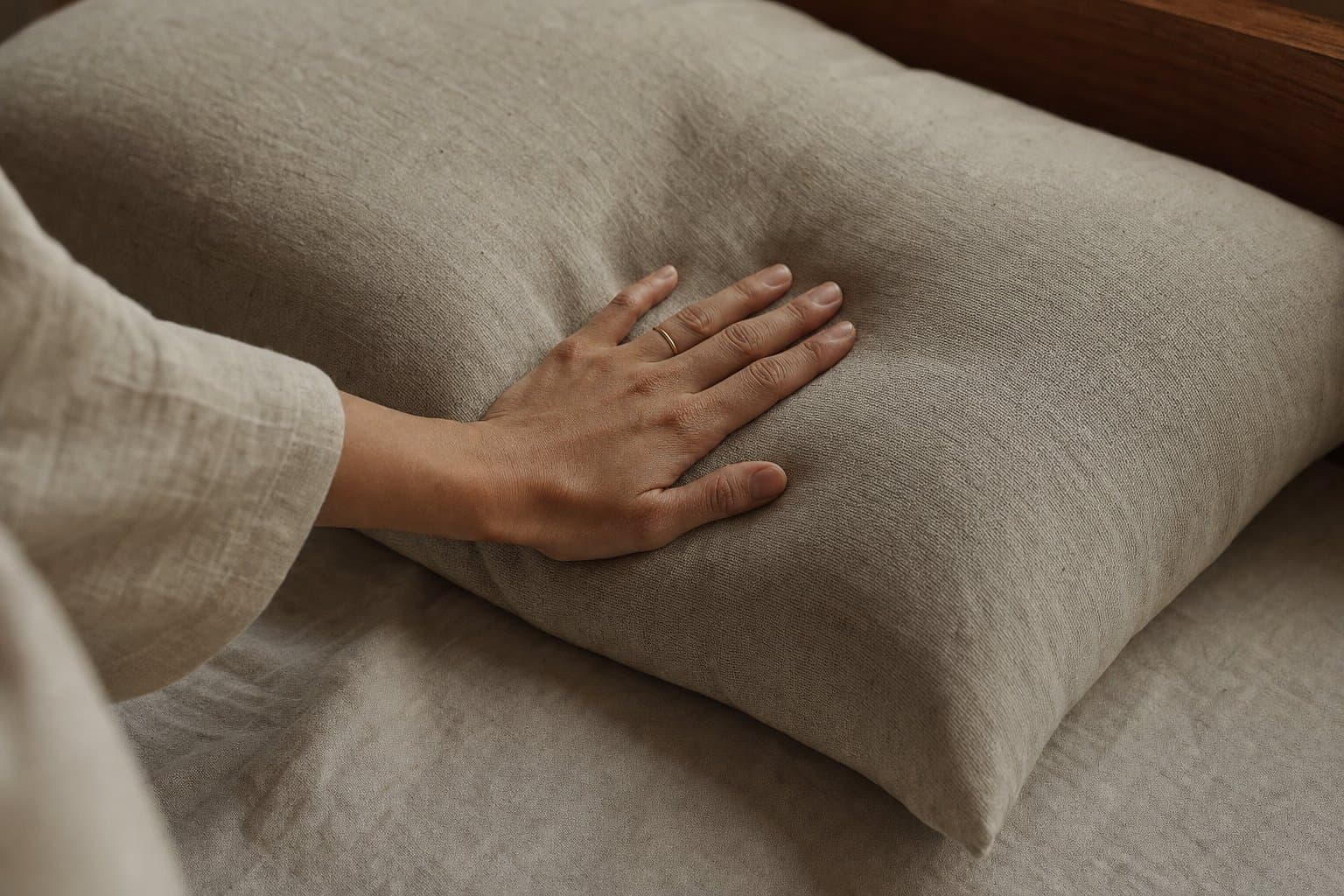
Treat these as starting points: shoulder width, body size, and mattress firmness all shift the ideal number. ③ Simulate the fix with a towel before you buy. If your current pillow feels too low, fold a bath towel in halves or quarters and slide it under the whole pillow, not just under your head. If it feels too high, remove fill or switch to a thinner pillow.
To support the neck alone, roll a face towel lengthwise and lay it along the near edge of the pillow, under the cervical curve. The towel method is a measuring tool, not permanent bedding — once you know which direction helps, buy the pillow that delivers it. ④ Choose material by how it supports. Buckwheat hulls and pipe fills hold their shape firmly; feather and polyester wrap softly; memory foam distributes pressure and contours to the neck; latex and breathable 3D mesh prioritize airflow.
Restless sleepers benefit from fast-recovering fills. If shoulder stiffness is your main issue, prioritize pillows designed to support the neck rather than merely cradle the head. Nishikawa Air, Tempur Original Neck Pillow, and Lofty Kaimin Makura are three well-known reference points built on different philosophies — memory foam, pipe fill, and made-to-measure — and their published specs are a reasonable place to compare. ⑤ Give it two weeks, then judge.
Necks need time to adapt, and first-night strangeness is not a verdict. Judge by how the morning feels. If neck pain is unchanged after a week, your height correction probably went the wrong direction. If mornings improve but you still wake at night, look at breathability and firmness instead. If pain or tingling persists for several weeks, stop buying pillows and consult an orthopedic clinic. Individual responses vary.
The takeaway: the pillow is the first step in sleep investment
Replacing a mattress runs into the tens of thousands of yen. Redesigning a bedroom, far more. A pillow, by contrast, can be reconsidered for a few thousand yen — and as Makura Hakusho 2025 shows, an ill-fitting pillow is likely a real cause of nighttime waking and morning heaviness for many people. The first step costs nothing at all: observation.
For the next three mornings, record your sleep position and where the pillow ended up, then use a folded towel to test which direction of height actually helps. Only after that should you buy, with a known target for loft and material. Done in that order, the odds of another wasted purchase drop sharply.
The three reference products mentioned above — Nishikawa Air, Tempur Original Neck Pillow, and Lofty Kaimin Makura — represent distinct approaches (memory foam, pipe fill, and made-to-measure) and are a solid starting point for comparison below. Individual results vary, and persistent pain deserves a clinician, not another pillow. To rebuild sleep from the ground up, see our take on sleepmaxxing as the broader framework this pillow decision sits inside, and sleep divorce if you share a bed. Once the pillow and mattress are settled, the next lever is the comfort of the room itself — light, texture, and sound.
FAQ
What is a rough height guideline for a pillow?
It depends on position. For back sleeping, aim for roughly 1–3 cm, enough that the chin sits slightly higher than the forehead. For side sleeping, you need to fill the shoulder gap so the neck and spine stay horizontal, which usually means around 4–6 cm. Stomach sleepers should go as flat as possible so the neck does not twist. Shoulder width and mattress firmness move the ideal number, so treat these as starting points and adjust based on how your neck feels in the morning.
What are the symptoms of a pillow that does not fit?
Common signs include pain at the back of the neck on waking, tightness where the neck meets the shoulder, tingling in an arm, snoring or shallow breathing, and waking during the night. Another clear clue is the pillow itself: if you find it pushed aside, folded in half, or tucked under your arm, your body was correcting the height while you slept. If symptoms continue for several weeks, consult an orthopedic clinic rather than cycling through more pillows.
My neck hurts from my pillow. What should I do first?
Do not buy first — find the direction first. If the pillow feels too low, fold a bath towel under it; if it feels too high, remove fill or switch to something thinner, then compare how your neck feels in the morning. If only the space behind the neck is unsupported, roll a face towel and place it along the near edge of the pillow to hold the cervical curve. Judge over several days, not one night. If pain or tingling drags on, see a medical professional instead of continuing to self-adjust.
Is it OK to adjust pillow height with a towel?
Yes, as a way to find the right direction. The key is to place the towel under the entire pillow, not under your head — a towel directly under the head deforms as you sink in and makes things less stable. Folding a bath towel in halves or quarters gives you discrete height steps, which makes morning-to-morning comparison easy. Towels do shift overnight, though, so treat this as a measuring tool rather than permanent bedding, and replace it with a pillow that delivers the loft you identified.
Which pillow should I choose if shoulder stiffness is my main problem?
Prioritize a design that supports the curve of the neck over one that simply cradles the head across a wide surface. Side sleepers in particular need enough loft to fill the shoulder gap; too low, and body weight concentrates on the shoulder. For material, fast-recovering pipe fill suits restless sleepers, memory foam suits those who want close contouring, and breathable types help if heat is an issue. The Japan Recovery Association survey found more than 70% experience neck or shoulder stiffness, so this is far from an unusual complaint. How much any change helps varies by person.
How long should I try a new pillow before deciding?
About two weeks. The neck needs time to adapt, so first-night discomfort is not a final verdict. Judge by how your neck and shoulders feel each morning. If morning pain is unchanged after a week, your height correction may have gone the wrong way. If mornings feel lighter but you still wake at night, suspect breathability or firmness rather than loft. If nothing works, or if pain persists, consider talking to a professional before buying yet another pillow.
About this article
This article was written by Lukas Weber (Writer / Sleep & Wellness, Data Verification) of the Tokyo Decoded editorial team, with sources and facts checked by the team. We keep editorial independence from advertisers. See our editorial policy.
Sources
Related

Sleepmaxxing 101: How the World Stopped Guessing and Started Optimizing Sleep
Sleepmaxxing has topped 80M views on TikTok. Here's the science of optimizing sleep—seen from Japan, where people sleep the least in the developed world.
Read more →
How Much Sleep Do You Need by Age? Japan's Official Answer
Japan's health ministry sets sleep targets by age. Here's how to turn those numbers into your own schedule.
Read more →
A Guide to the World's Life-Optimization Trends: Sleep, Rest, and Owning Less
Sleepmaxxing, Bed Rotting, Underconsumption Core — a single map of the world's trends for a better-designed life. Sleep, rest, and belongings, tuned by data rather than by feel.
Read more →