
Heating Cost in Japan: The One Formula That Prices Every Heater
Heating cost in Japan comes down to one formula: watts ÷ 1000 × hours × 31 yen. Here's how to price your own heater.
 By Lukas WeberWriter / Sleep & Wellness, Data Verification·2026.09.30 published·2026.09.30 updated·5 min read·2 sources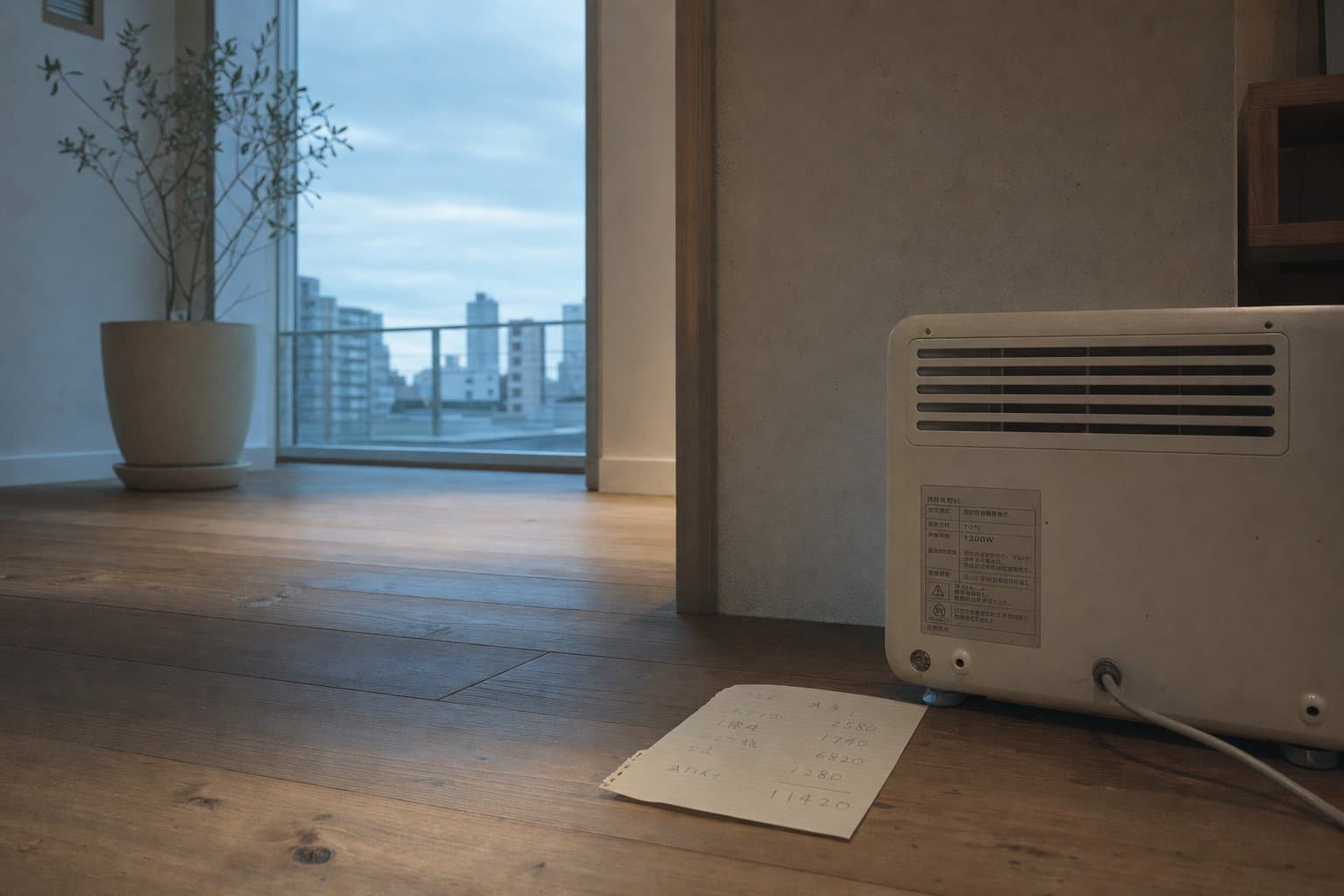
You probably remember the moment last winter when the electricity bill arrived and you just stared at it. February spiked, and yet by the time spring came you still didn't know which appliance was responsible. Then October arrives and you start searching all over again. What usually comes back is a comparison table of heater types — but those numbers belong to someone else's model, not the air conditioner in your living room or the kotatsu under your table.
This article reverses the order. Before comparing machines, get hold of one formula. Every electric heater's running cost comes out of it, without exception: watts ÷ 1000 × hours of use × price per kilowatt-hour. That's the whole thing. Once you carry that formula, you can stand in front of a spec sticker in a home appliance store, or scroll a product page at midnight, and price the thing yourself. The goal here is to stop you from hunting for averages that were never about your home.
Start by fixing the unit price. The Japan Electrical Home Appliances Fair Trade Council publishes a reference electricity rate used across the appliance industry: 31 yen per kWh including tax, revised in July 2022. When a Japanese appliance ad says "about X yen per hour," that figure is usually calculated with this reference rate.
It is, in effect, the shared ruler. Now the formula: watts ÷ 1000 × hours × 31 yen. A device rated at 500W run for one hour costs 500 ÷ 1000 × 1 × 31 = about 15.5 yen. A 1200W device costs about 37.2 yen per hour. An 800W device, about 24.8 yen. Notice what is absent: no category average, no someone-else's-model estimate.
All you need is the wattage printed on your own appliance or in its manual. Your actual contracted rate will differ by utility and plan, so if you want precision, swap 31 for the figure on your own bill. The shape of the formula does not change. That substitutability is exactly why the formula belongs in your hands before any comparison table does.
So why do category averages fail in a Japanese home? Because each method heats a different target over a different stretch of time. An air conditioner warms the air of the whole room, and critically, its power draw swings with operating conditions — high on startup, dropping as the room approaches the setpoint.
That is why an air conditioner cannot be lined up against other appliances with a single fixed wattage. Its spec sheet gives a rated figure plus a minimum-to-maximum range, and the range is the honest reading. Resistive heaters — electric stoves, panel heaters — are the opposite: while switched on, they draw close to their stated wattage continuously.
They heat fast and they excel at "right now, right here" zones like a cold entryway or a changing room. But a 1200W unit accumulates roughly 37.2 yen every hour without relief. The kotatsu is Japan's own answer: it heats only the sealed pocket under a quilt, so its rated wattage is small and many models cycle the element off once the space holds temperature.
An electric carpet works on the same logic — heat only the surface a person occupies. Japanese winters therefore run two philosophies at once: the Western instinct to warm a whole room, and the local instinct to press warmth against the body. Dryness splits along the same line. Air conditioners move a lot of air and feel drying, which is why heating sits next to humidity in any indoor-comfort plan.
On safety, resistive heaters get genuinely hot at the surface, so distance from bedding and laundry, and remembering to switch off before sleep, matter.
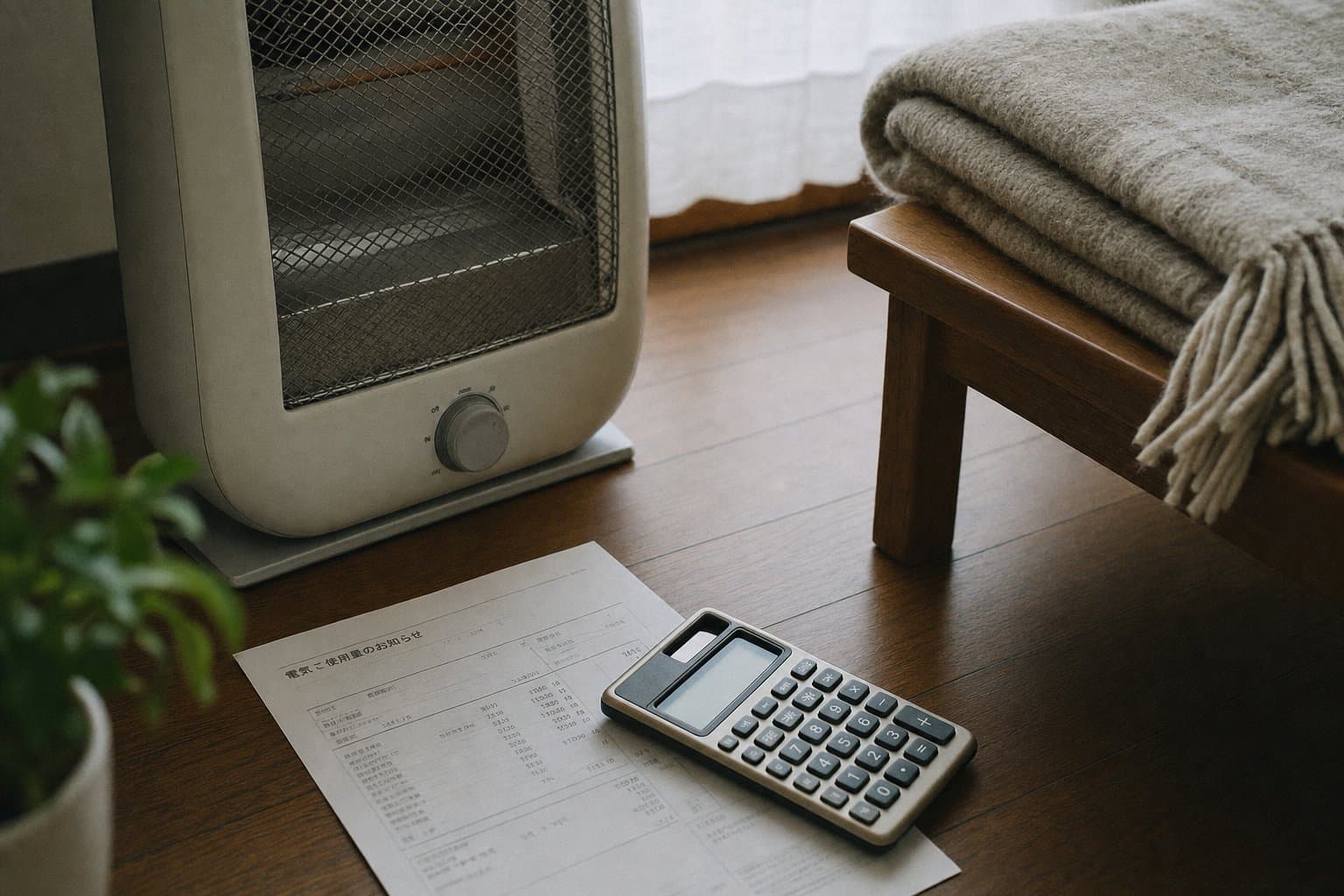
- Write down the wattage of every heater you own. It's on the nameplate or in the manual. For the air conditioner, record the range — rated watts plus minimum and maximum — not a single number.
- Convert each one with watts ÷ 1000 × 31 yen. 600W is about 18.6 yen per hour; 1000W is 31 yen; 300W is about 9.3 yen.
Memorising just those three makes you fast in a store aisle.
- Multiply by daily hours, then stretch it across a winter. Five hours a day for ninety days is 450 hours; an 18.6-yen-per-hour device comes to roughly 8,370 yen. Only at this scale does "expensive" or "cheap" become a sentence about your own life.
- Separate the room from the body.
Air conditioning for the whole room, and a kotatsu, panel heater or electric carpet for the desk and the dining table — this split suits Japanese housing, because effective local heat creates room to lower the thermostat.
- If you're buying, compare on stated watts and controls. Organising public spec information side by side: Iris Ohyama's electric blankets carry low wattage figures suited to short pre-bed runs; Yamazen's electric stoves offer high/low switching, meaning you can lower the number you put into the formula; and for a kotatsu, Nitori's kotatsu futon sets illustrate why the quilt matters — a kotatsu is cheap to run only because the futon refuses to let heat escape.
- Build the base layer too. Better bedding insulation reduces the heating you need overnight, and that reduction goes straight into the formula.
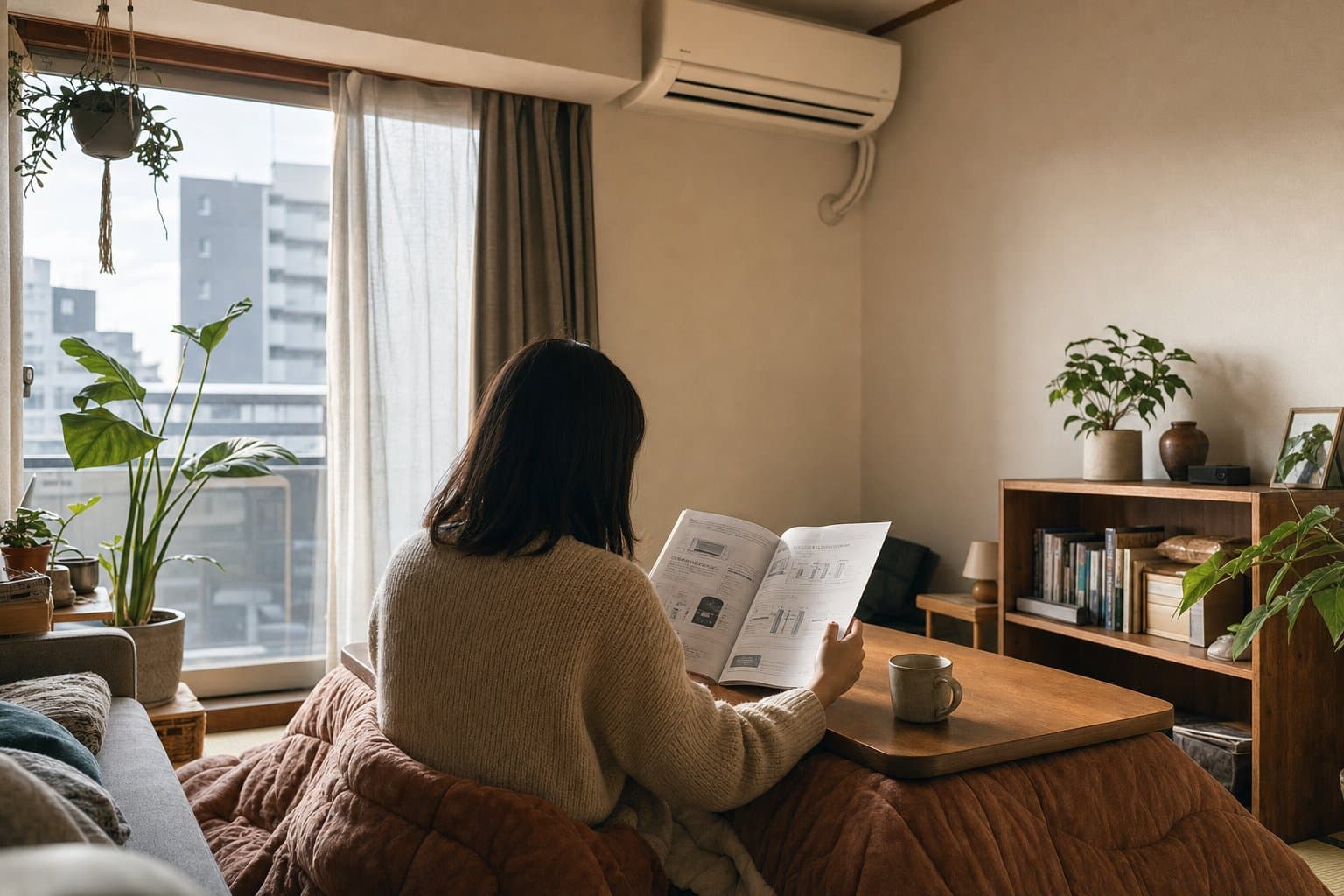
To close: heating cost is not a ranking of methods, it's watts × hours × price. Hold the Fair Trade Council's reference rate of 31 yen/kWh as your constant, plug in your own appliance's wattage, and you no longer need anyone's comparison table. And one degree on the thermostat carries more weight than it sounds.
TEPCO Power Grid calculates that running a 2.2kW air conditioner in heating mode at an outdoor temperature of 6°C, nine hours a day for 169 days (October 28 to April 14), and lowering the setpoint from 21°C to 20°C, saves roughly 53.08 kWh — about 1,650 yen over that season at 31 yen/kWh. The practical move isn't to endure one degree colder; it's to warm your feet locally so that one degree stops mattering. Two things to do today.
Note the wattage of every heater you already own and convert it to yen per hour. Then prepare one local-heat option. The Iris Ohyama electric blanket, Yamazen electric stove and Nitori kotatsu futon set mentioned above all serve the same role: local warmth that buys you a lower room setpoint. Compare their wattage and price below and run them through your own formula. The winter bill stops being a shock the moment the numbers belong to you.
About this article
This article was written by Lukas Weber (Writer / Sleep & Wellness, Data Verification) of the Tokyo Decoded editorial team, with sources and facts checked by the team. We keep editorial independence from advertisers. See our editorial policy.
Sources
Related
Cold Feet at Night in Japan: Comparing Four Local Heating Options
Four ways to warm cold feet at night in Japan, compared on burn risk, running cost, and care.
Read more →
Heat Shock and Japanese Bath Safety: Three Numbers for Winter
In Japan, winter bathtub deaths outnumber traffic fatalities. A cost-free-first checklist from official data.
Read more →
Ragweed Season in Japan: Why Your September Cold Won't Go Away
A September cold that lingers may be autumn pollen. What Japan's ragweed season is, and how to handle it at home.
Read more →