
How to Choose a Duvet in Japan: Read the Label, Not the Adjectives
Down, wool, synthetic: three different kinds of warmth. Choose by Gold Label grades and legal labeling, not by feel.
 By Lukas WeberWriter / Sleep & Wellness, Data Verification·2026.09.28 published·2026.09.28 updated·7 min read·2 sources
You wake at 4 a.m. with cold feet, but the afternoon still feels like summer. So the thin summer cover stays on the bed, and September quietly runs out. This is the week most people in Japan stand in a bedding aisle and stall.
The difficulty is that almost everything written on the shelf is an adjective. Fluffy. Warm. Light. None of it is false, and none of it lets you compare one duvet to the one beside it. How something feels in a three-second touch test tells you surprisingly little about what is inside it.
But a duvet always carries information that is not adjectival. For down comforters, there is down power, down content ratio, and cleanliness. For every textile product sold in Japan, there is the labeling required under the Household Goods Quality Labeling Act. The organizations behind those numbers publish their criteria openly, which means anyone can read them with the same ruler.
This article names no prices — we have no sourced figures for them. Instead it explains what the numbers on the tag mean, and how down, wool, and synthetic fills differ in the kind of warmth they produce. By the end, the first thing you look at in the store will have moved: from the price tag to the quality tag.
Down power explained: the four Gold Label grades and their numbers
The entry point for reading a down comforter numerically is the Gold Label issued by the Japan Down Products Cooperative Association. It is a quality recommendation label in four grades, each with published criteria.
**Premium Gold Label**: down power 440dp or above, down content 93% or above
**Royal Gold Label**: 400dp or above, 90% or above
**Excel Gold Label**: 350dp or above, 80% or above
**New Gold Label**: 300dp or above, 50% or above
Down power (dp) measures loft — the fill's ability to expand. A higher figure means more trapped air for the same weight, and since a duvet's warmth is essentially a structure made of still air, the number describes how efficiently that structure is built. Down content ratio is the share of the fill that is true down, the soft clusters from a waterfowl's breast. The remainder is feather, which has a quill and therefore does not loft in the same way.
Two hygiene criteria sit alongside them. Cleanliness must be 1000mm or above for Premium and Royal, and 500mm or above for Excel and New. The oxygen number must be 4.8mg or below across all four grades. Cleanliness reflects how little residue remains in the down; the oxygen number reflects residual organic matter. Both are washing quality, expressed as figures.
The key point is that these four grades are an ordering of criteria, not of prices. The label itself does not tell you how many dp is "enough." (Source: Japan Down Products Cooperative Association, "Gold Label quality recommendation labels for down comforters.")
Why down, wool, and synthetic warm you differently — and why Japan shops by brand
Why does choosing by the word "warm" go wrong so often? Because down, wool, and synthetic fills produce warmth by different mechanisms. The same adjective describes three different designs.
**Down**: warms by lofting and holding air. It feels light at the moment you pull it up, then drapes along the body as it warms. Care is mostly airing and washing the cover; full washing depends on what the product's own label permits. This is the only one of the three with a third-party grading system in Japan — the Gold Label.
**Wool**: the fibre itself absorbs and releases moisture, so it manages the clammy side of sleep rather than raw insulation. It tends to be heavier than down, which some people read as reassuring weight. It earns its place for sleepers who feel hot and cold at the same time.
**Synthetic (polyester and similar)**: builds air layers through engineered fibres such as hollow strands. Many are machine washable, and ease of handling is the defining trait. Because they are manufactured uniformly, variation between units is small and labeling tends to be straightforward.
A distinctly Japanese pattern sits on top of this. Bing search volumes show "Nishikawa futon" at 6,072, "futon" at 5,695, and "Nitori kakebuton" at 309 — bedding here is a brand-first search market. Most people begin with a brand name. But what actually differs inside a brand is decided by the fill type and the figures on the tag. Starting from a brand is fine; the ruler you compare with should still live on the label.
This is the third entry in a line of thinking we have used for how to choose a pillow and mattresses and back pain: a bed has fewer subjective decisions in it than it appears to.
How to start: choosing and switching your duvet in five steps
Turn the autumn switch into a procedure rather than a feeling. Five steps.
**① Reduce your complaint to one sentence.** Is it cold feet at dawn, waking up clammy, or weight that makes turning over hard? Insulation, moisture handling, and fill weight are three different targets. Until this sentence exists, no number on a tag is relevant.
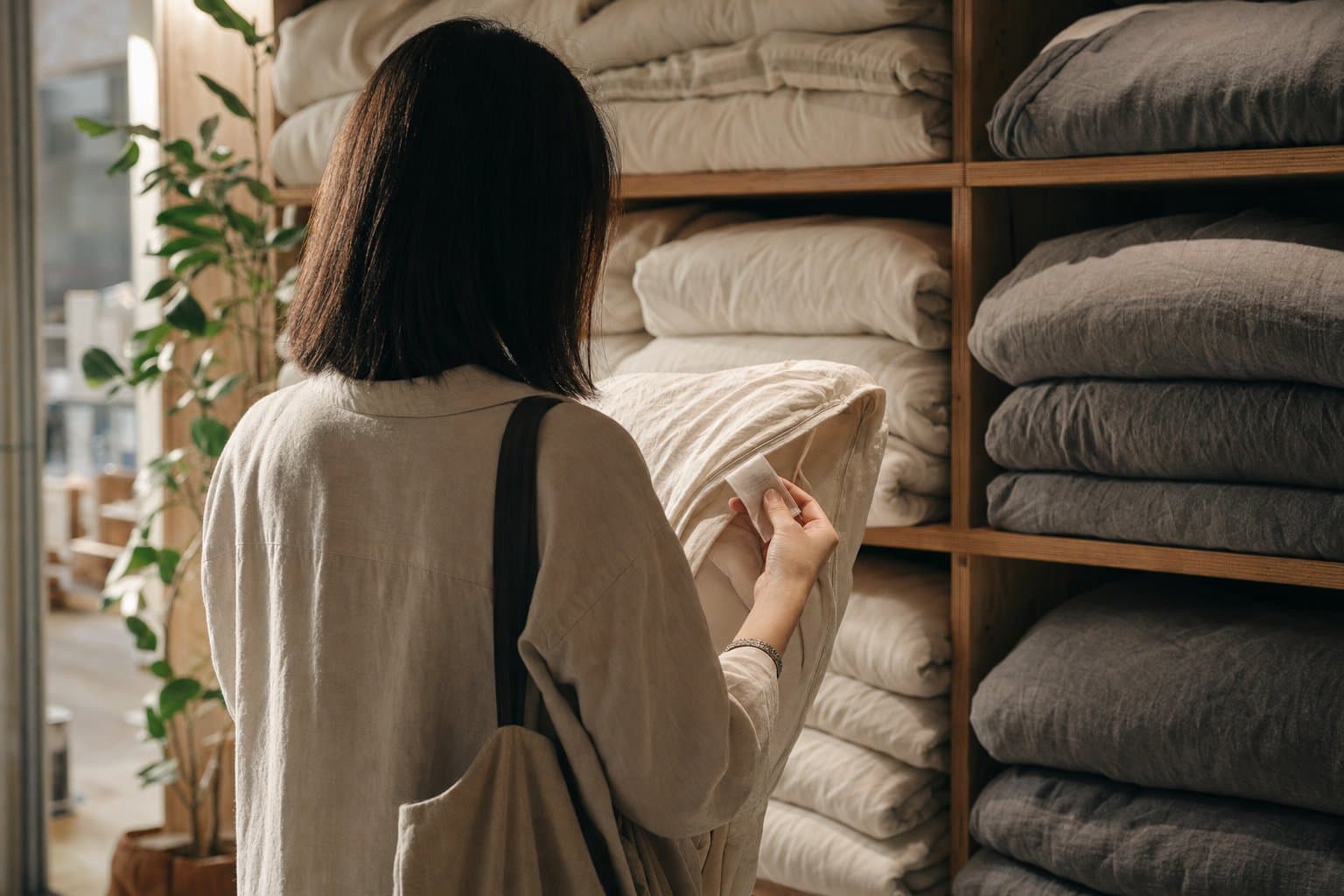
**② Read the label's required disclosures before the price.** Under the Household Goods Quality Labeling Act, textile products must state fill type, blend ratios, and care instructions (Consumer Affairs Agency, "Labeling of textile products"). For down, the "down X% / feather Y%" line lives here. Make opening this tag the first motion in the aisle.
**③ If you are considering down, line products up by Gold Label grade.** Premium 440dp, Royal 400dp, Excel 350dp, New 300dp — the published criteria let you compare like with like, alongside cleanliness at 1000mm/500mm and the oxygen number at 4.8mg or below. Nishikawa down comforters publish detailed specifications on their brand pages, which makes them a convenient place to practice matching a grade against its stated down ratio.
**④ Make washability an early fork, not an afterthought.** Care realities often outrank performance. Nitori duvets include machine-washable synthetic lines, and if you cannot reliably air bedding or you sleep alongside a small child, that is where the shortlist starts. Rakuten's down comforter listings put multiple brands' spec tables side by side, which is useful when you want to compare Gold Label grade, down ratio, and fill weight on one screen.
**⑤ Do not swap to one heavy layer overnight — build it.** Late September still swings. Add a blanket to the summer cover, or lay a light blanket over the down (placing the blanket closer to the body changes how it reads). Test for a few nights, then pick the date the full duvet goes on. The switch is a two-to-three-week adjustment, not a single event.
The takeaway: choosing a duvet starts at the tag
A duvet may be the single piece of bedding most often bought on impression. Yet down has a four-grade public standard in the Gold Label, and every textile product sold here carries disclosures required by the Household Goods Quality Labeling Act. There is more readable information than most shoppers assume.
If you do one thing tonight, open the tag on the duvet you already own and photograph it. Fill type, blend ratio, care instructions. Once you know that, the next purchase becomes a question of what to add rather than what to replace blindly.
When you compare — in a store or online — starting from a brand is fine. Nishikawa down comforters disclose specifications in enough detail to check a Gold Label grade against its stated down ratio; Nitori duvets lead with washable synthetic lines for people who need easy care; Rakuten's down comforter listings make it straightforward to scan down power, down ratio, and fill weight across grades in one place. You can compare their specifications below.
Just keep the order. Narrow by brand, then decide by the numbers on the tag. Reverse it, and you will be buying "looks warm" all over again.
Sources: Japan Down Products Cooperative Association, "Gold Label quality recommendation labels for down comforters"; Consumer Affairs Agency, "Labeling of textile products" (Household Goods Quality Labeling Act).
About this article
This article was written by Lukas Weber (Writer / Sleep & Wellness, Data Verification) of the Tokyo Decoded editorial team, with sources and facts checked by the team. We keep editorial independence from advertisers. See our editorial policy.
Sources
Related
Mattress for Back Pain: How to Rethink Where You Sleep 8 Hours
Back pain tops Japan's health complaints. A practical guide to choosing a mattress by firmness, pressure distribution, and breathability.
Read more →
How to Choose a Pillow: Height Guide by Sleep Position
Nearly 60% feel their pillow doesn't fit. A practical guide to height and material by sleep position.
Read more →
Heat Shock and Japanese Bath Safety: Three Numbers for Winter
In Japan, winter bathtub deaths outnumber traffic fatalities. A cost-free-first checklist from official data.
Read more →