
What Is Fibermaxxing? The Fiber Trend Japan Already Eats
Fibermaxxing came from US TikTok. Japan's answer is already on the table: natto, miso, kiriboshi daikon.
 By Sofia ReyesDesigner / Lifestyle & Comparison Guides·2026.09.16 published·2026.09.16 updated·6 min read·3 sources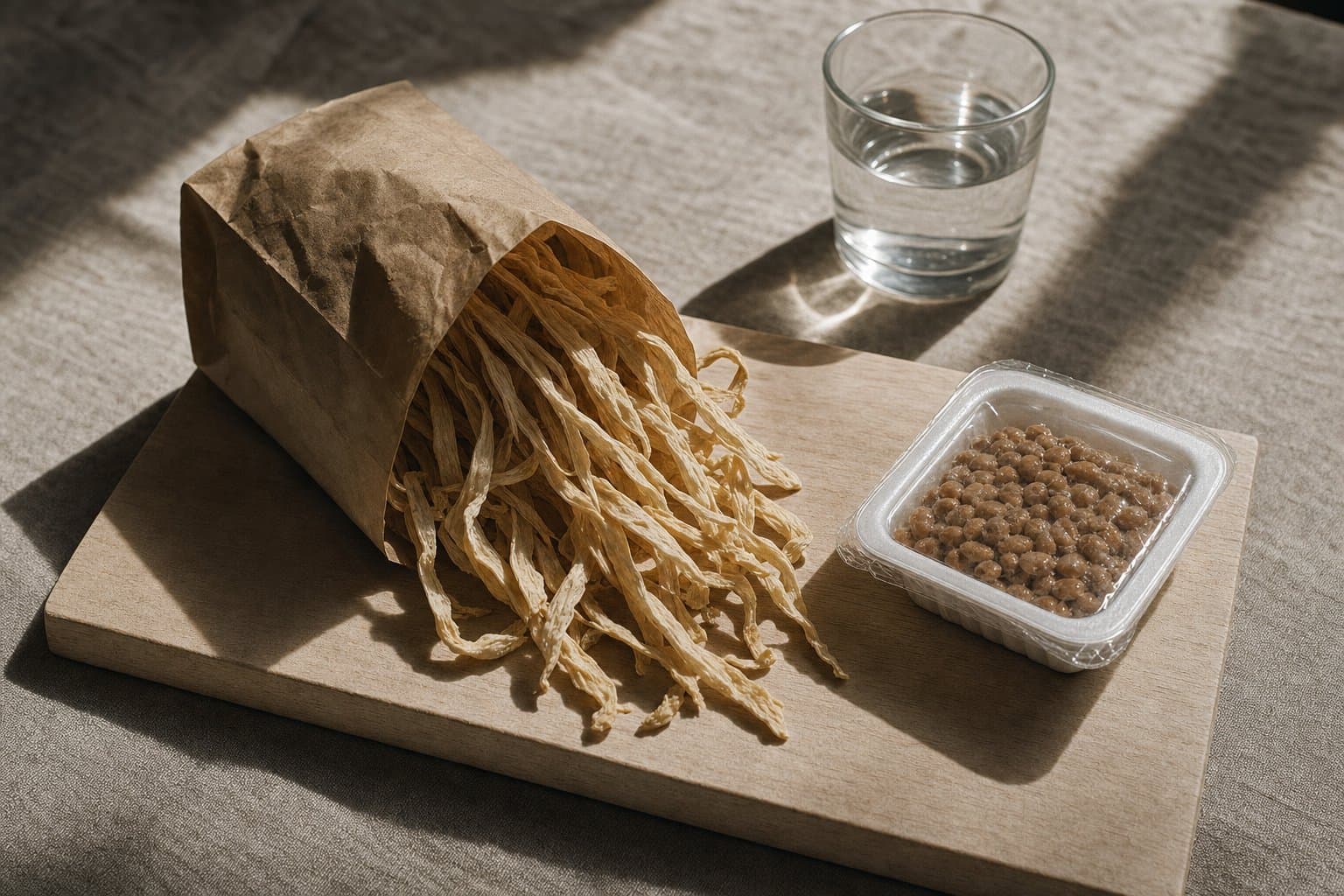
Fibermaxxing is the practice of deliberately adding as much dietary fiber to your day as you reasonably can. The term came out of US TikTok, arriving as a correction to several years in which protein was the only macronutrient anyone talked about. By 2025–26 the pendulum had swung, and the swing got a name.
The name is the problem, though. "Maxxing" implies that more is always better, and it points toward buying things — powders, capsules, gut-health subscriptions. Translated onto a Japanese table, the trend becomes far less dramatic. One more pack of natto. Dried daikon in the miso soup. A spoonful of barley in the rice cooker. Mostly it is a rearrangement of what is already in the kitchen.
This piece does three things: define the term, put the actual Japanese numbers next to it, and — importantly — describe what happens when you overshoot. We are not going to end on "add more."
What is fibermaxxing? The 25g target vs. 19.9g reality
Put numbers on fibermaxxing in Japan and a clear gap appears.
Japan's Ministry of Health, Labour and Welfare, in the 2025 edition of its Dietary Reference Intakes, signalled a move toward a daily fiber target of roughly 25g for adults. Actual intake, per the 2019 National Health and Nutrition Survey, sits at about 19.9g for men and about 18.0g for women. The gap is real and it is documented.
That is roughly 5g short for men, 7g for women. It is not a gap that requires rebuilding your diet. It is one or two additional dishes: a pack of natto, some simmered dried daikon, a scoop of boiled soybeans. Understanding the scale makes the trend far less intimidating — and far less expensive.
There is a second, more interesting number. A private survey published in March 2025 found that **87.9%** of respondents did not know that 25g or more per day is considered desirable, while **73.7%** believed they personally were not getting enough. People sense the shortfall but do not know the target. That asymmetry is exactly the space an imported wellness term moves into — and it is why "just add more" so often becomes "just buy a supplement."
(Sources: MHLW Dietary Reference Intakes for Japanese, 2025 edition; 2019 National Health and Nutrition Survey; private survey published March 2025.)
Why is fibermaxxing structurally easier in Japan? The answer is in the refrigerator and the dry-goods shelf.
Miso, natto, nukazuke pickles, kiriboshi daikon. In a Japanese meal, fermented foods and fiber sources are not separate categories to be assembled — they already co-occur in the same set of dishes. The combination that English-language wellness culture is currently rediscovering under names like "gut health" and "fibermaxxing" exists here as a menu, not a protocol. Kiriboshi daikon is simply daikon with the water removed, which concentrates fiber per gram. Nukazuke is a vegetable that has been fermented by the act of pickling it.
One caution. Do not read "gut health" as a universal remedy. A great deal of writing links fiber directly to immunity, mood and weight; this article will not. What can responsibly be said is narrower: average intake in Japan falls short of the national target, and the shortfall is small enough to close with ordinary groceries.
And a second caution. Do not accept the "maxxing" framing at face value. Fiber is not a variable where higher is unconditionally better — more on that at the end of the next section.
Answering an imported trend by looking in your own kitchen rather than at a checkout page is the same instinct we wrote about in underconsumption core.
How to start fibermaxxing — 4 steps from your staple grain
How to start fibermaxxing — four steps, plus a brake
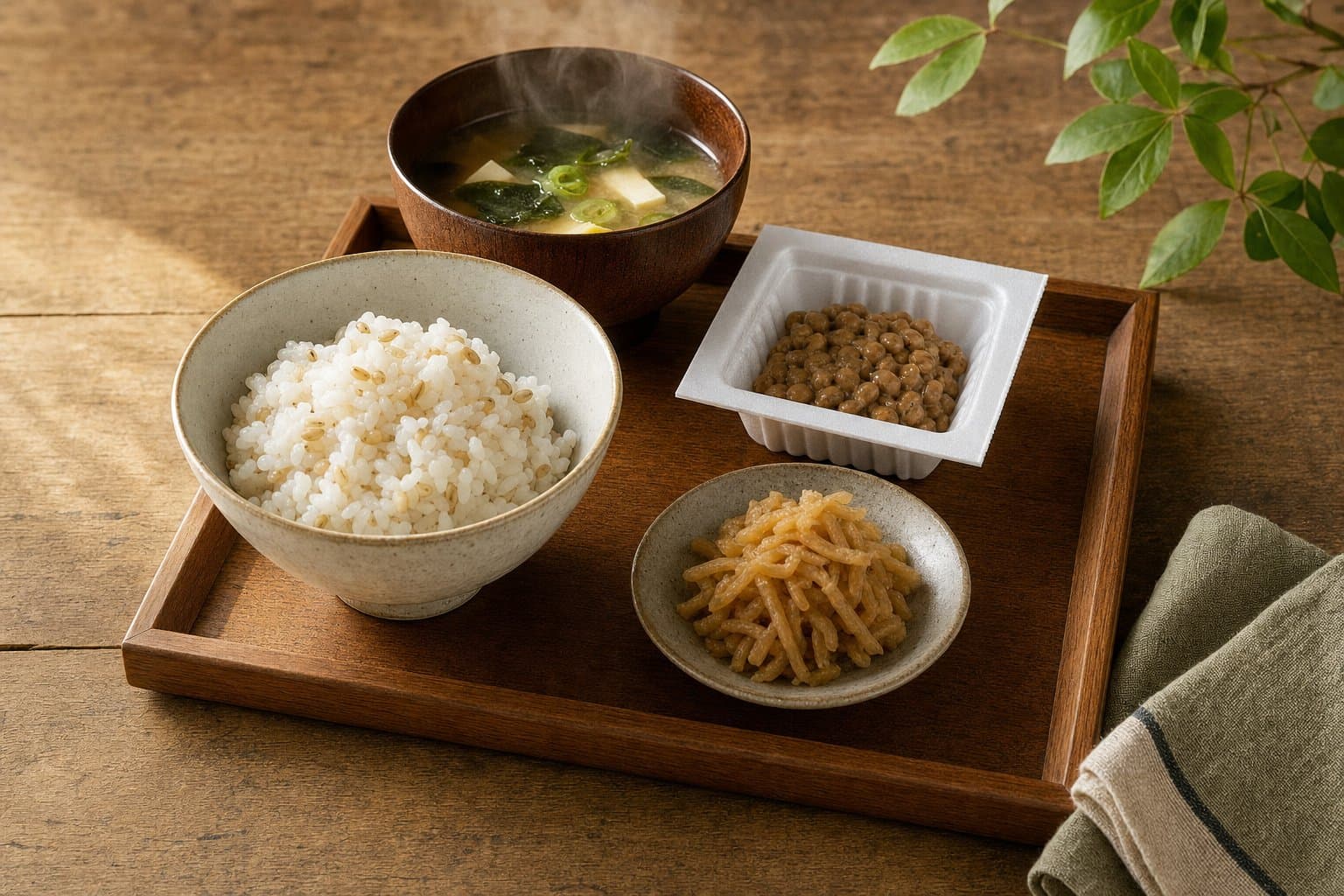
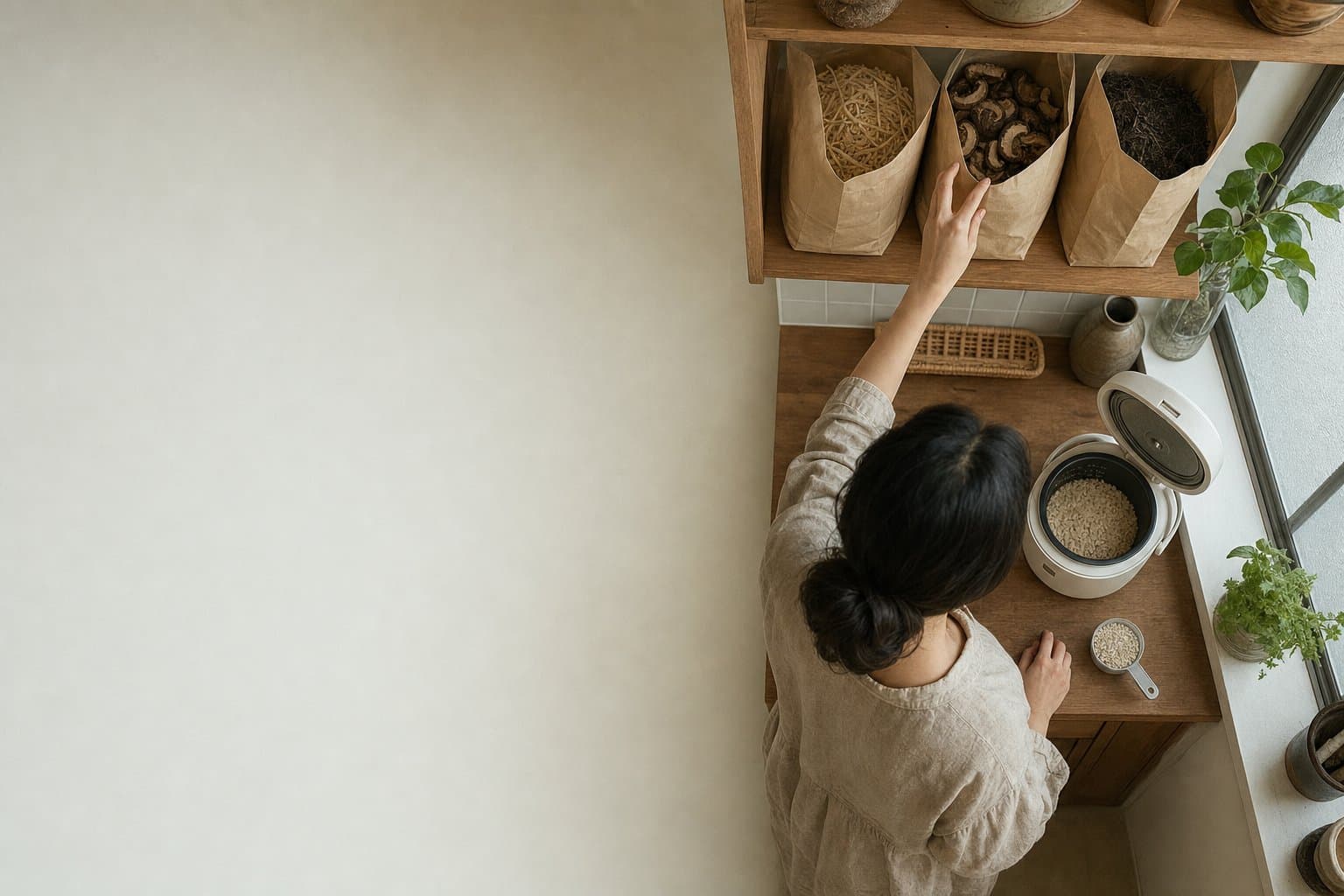
**① Change one staple.** Stir barley into your rice, or switch to whole-grain bread. Staples are eaten daily, so a single decision compounds 365 times a year. Pre-portioned products such as **Hakubaku Mochimugi Gohan** drop straight into the rice cooker without measuring.
**② Reactivate the dry-goods shelf.** Kiriboshi daikon, dried shiitake, hijiki. Rehydrate and drop into miso soup and you have a dish. Dry goods keep at room temperature, so stocking up does not create waste.
**③ Put fermentation and fiber on the same plate.** Natto with okra or mekabu; miso soup with root vegetables. Japanese menus have done this for centuries. No new recipes required.
**
- Keep one backup for the days it all collapses.** Travel and restaurant weeks kill steps
- to
- . Comparing publicly available specs: **Easy Fiber (Kobayashi Pharmaceutical)** is a near-tasteless indigestible dextrin powder you dissolve into drinks or soup; **Sunfiber (Taiyo Kagaku)** is a guar-derived soluble fiber, also dissolved; **Mil-Mil (Yakult)** is a fermented dairy drink with fiber added, requiring refrigeration rather than shelf storage. Powders let you dose in small increments but require measuring; drinks remove the effort but fix the serving size.
**⑤ Now the brake.** Increase too fast and your gut will object. Rapid jumps in fiber — insoluble fiber especially — can cause bloating, gas, and ironically constipation. Increase water intake alongside it, and raise your total by roughly 2–3g at a time over one to two weeks. Do not let the word "maxxing" push you toward 25g overnight. If constipation or abdominal pain persists, or if you have an existing condition or are under treatment, consult a doctor or pharmacist rather than self-adjusting.
The takeaway: fibermaxxing is a rearrangement
The takeaway: fibermaxxing is a rearrangement, not a shopping list
To recap. Fibermaxxing means deliberately raising your fiber intake. Japan's target is around 25g per day (Dietary Reference Intakes, 2025 edition); actual intake is about 19.9g for men and 18.0g for women (2019 National Health and Nutrition Survey). The 5–7g gap is closable with natto, dried daikon and barley in the rice. And 87.9% of people do not know the 25g figure at all — knowing the number is itself step one.
If you do one thing this week: **buy barley the next time you buy rice.** It is the hardest step to abandon. Adding a bag of kiriboshi daikon to the dry-goods shelf works the same way. If you eat out or travel often, keeping one backup — a powder such as Easy Fiber or Sunfiber, or a drink such as Mil-Mil — is a reasonable design. The differences in format, storage and serving size are laid out above, and you can compare specifications and order below.
One last time: more is not the goal. Increase too fast and you will bloat; skip the water and you may make things worse. Move in 2–3g steps, with fluids. If constipation or abdominal pain persists, see a doctor.
Answering an imported word with a Japanese table is the same move as underconsumption core: the answer is usually already in the house.
About this article
This article was written by Sofia Reyes (Designer / Lifestyle & Comparison Guides) of the Tokyo Decoded editorial team, with sources and facts checked by the team. We keep editorial independence from advertisers. See our editorial policy.
Sources
- Ministry of Health, Labour and Welfare, “Dietary Reference Intakes for Japanese (2025)” report (Japanese) — 厚生労働省
- Ministry of Health, Labour and Welfare, “National Health and Nutrition Survey 2019 (Reiwa 1) Report” (Japanese) — 厚生労働省
- AuB Inc., survey: 87.9% unaware that 25g+ of dietary fiber per day is recommended (PR TIMES, Mar 2025, Japanese) — AuB株式会社
Related
Sleepmaxxing 101: How the World Stopped Guessing and Started Optimizing Sleep
Sleepmaxxing has topped 80M views on TikTok. Here's the science of optimizing sleep—seen from Japan, where people sleep the least in the developed world.
Read more →
Underconsumption Core: Why Buying Less Is the New Flex
TikTok's #underconsumptioncore hits 230M views. The new flex? Buying less—and Japan's been doing it forever.
Read more →
Beginner Houseplants: Plant Parenthood for Small Tokyo Apartments
Plant parenthood starts with picking the right species. A calm guide to beginner houseplants that survive small, low-light Tokyo homes.
Read more →