
How to Minimize Enlarged Pores: The Skin Barrier Turn
Pores top Japan's 2026 skin-concern survey. The global shift: stop stripping, start protecting.
 By Jiwoo SeoSocial Media / Beauty & Skincare·2026.09.14 published·2026.09.14 updated·4 min read·1 sources
You lean toward the mirror, pull the skin beside your nose sideways, and the shadows soften. Then you let go, and they return. For years the Japanese answer to that moment has been subtraction: stronger cleansers, peel-off packs, scrubs, anything that promises to pull the clog out. Meanwhile, in the US and Korea, the vocabulary has flipped.
Skin barrier repair. Slugging — sealing the last step of your night routine with a thin occlusive layer so the skin is protected rather than sanded down. It is a correction, not a fad: after a decade of aggressive exfoliation, the conversation moved toward what the skin needs to keep. That reversal is worth translating carefully, because pores are the single most common skin concern in Japan right now.
In this piece we separate three things Japanese beauty talk tends to blur — visible pores, sagging-related pores, and clogged pores — and rebuild a night routine around protection.
Start with the map. In a 2026 skin-concern survey of 1,000 people aged 10 to 59 in Japan, pores ranked first for both women and men: 51.4% of women and 34.0% of men. One in two women, one in three men, all looking at the same few square centimetres. Very few concerns cut across age and gender that cleanly — which is exactly why the shelf is crowded with verbs like remove, strip, and tighten, and why searching only multiplies the options.
The useful move here is not another product but a distinction. The single word "pores" is doing three jobs at once: clogging, where sebum and dead cells collect at the opening; visible openness, which shifts with dryness and sebum; and sagging-related pores, the teardrop shadows that appear on the cheeks. Different mechanisms, different responses.
No single step addresses all three, and treating them as one problem is how people end up over-exfoliating. Source: 2026 Japan skin-concern survey, 1,000 respondents aged 10–59.
Why does Japan default to stripping while the global conversation moved to protecting? Partly history. In Japan, pores have long been framed as dirt: clogged, therefore washable. Cleansing oils, peel-off packs and wipe-off toners all follow from that premise. In the US and Korea, a decade of enthusiastic acid use produced a visible backlash — redness, stinging, dehydration — and the discourse shifted to the skin barrier, the outermost layer that holds water in and buffers irritation.
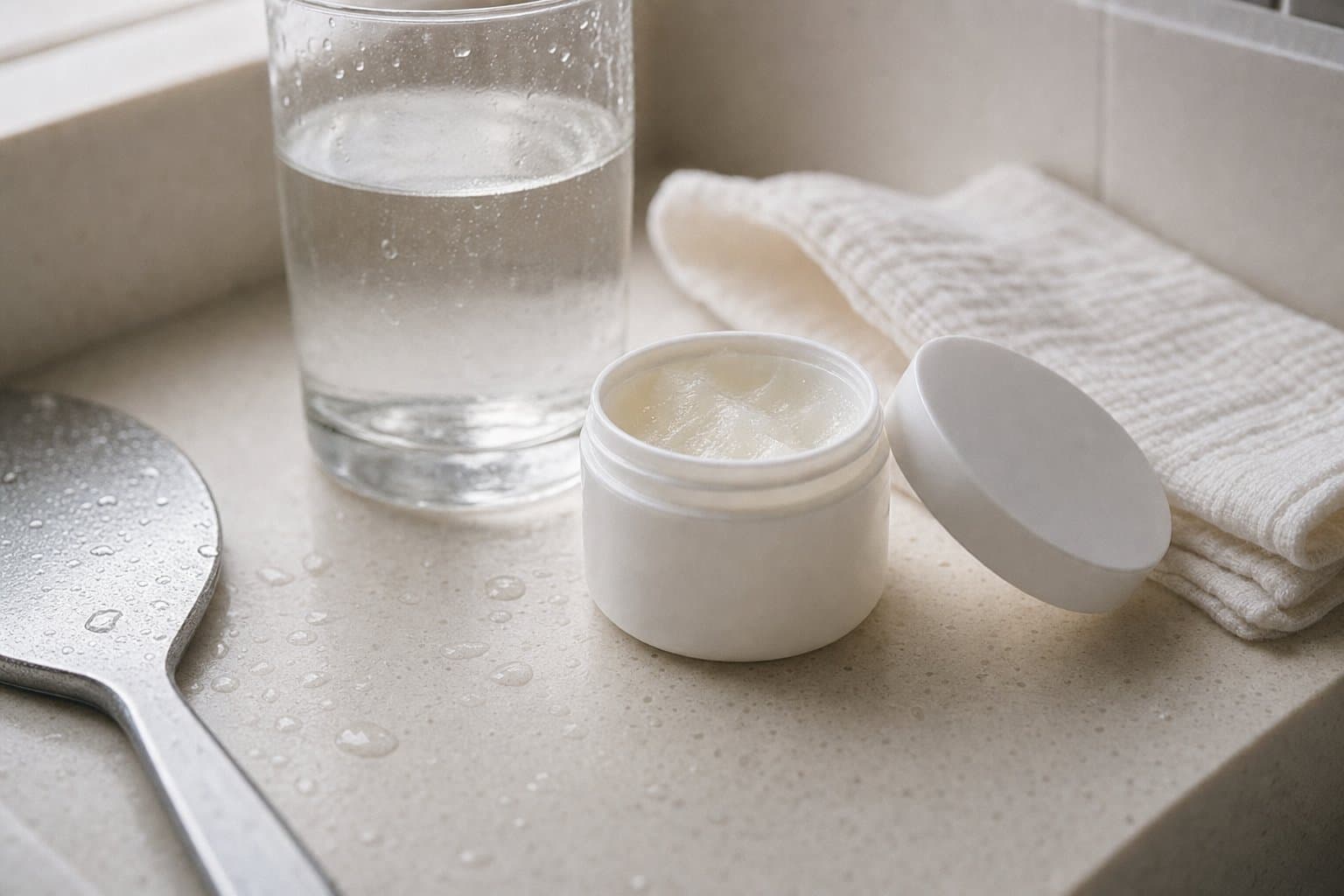
Slugging came out of that shift: a thin occlusive layer applied as the final night step so moisture is less likely to escape. The important correction is that sebum is not the villain. It is part of how the surface protects itself, and skin that is short on water can behave in ways that make pore shadows more noticeable, not less.
Reframed that way, "smooth and soften the look" is a more coherent goal than "scrub it smaller." It runs parallel to slow aging and to the wider direction of 2026's global beauty trends.
- Separate. Decide which of the three you are actually looking at. Pull the skin gently sideways: if the shadows fade, the sagging component is doing more of the work than clogging.
- Subtract. Pause scrubs, peel-off packs and wipe-off toners for one or two weeks. The more aggressive your current routine, the more visible this step is.
- Simplify the base.
A low-irritation cleanser plus a ceramide-focused moisturiser. We organised widely available options from public product information rather than testing them: Curél Intensive Moisture Care is the familiar ceramide-oriented line for dryness-prone skin, while Orbis Medicated Clear Full is formulated with lower oil content for skin where oiliness and dryness coexist. ④ Try slugging. Two or three nights a week, finish the routine with a very thin layer of white petrolatum — Sun White or Vaseline Pure Skin Jelly.
A rice-grain amount is enough; thickness adds nothing. Start on drier areas such as the cheeks and skip zones that clog easily. ⑤ Hold for four weeks and judge by photo, not by mirror — one shot a week, same light, same distance.

The takeaway: protect, don't strip
To close: trying to "fix" enlarged pores with one decisive product tends to push people toward harsher routines and a longer detour. Separate openness, sagging and clogging. Subtract first. Rebuild the base around moisture. Then, only at the end, add a thin seal. What the global skin-barrier conversation arrived at is unglamorous, and that is the point.
Two things you can do tonight. Write "rest day" on the calendar for anything that strips. Then pick one moisturiser based on whether your skin runs dry or runs oily-and-dry at once: Curél Intensive Moisture Care for the former, Orbis Medicated Clear Full for the latter, with white petrolatum — Sun White or Vaseline Pure Skin Jelly — as the optional night seal.
Sizes, prices and formulation notes can be compared and ordered below. In four weeks, line up your weekly photos under the same light. Your own skin is the only evidence that counts.
About this article
This article was written by Jiwoo Seo (Social Media / Beauty & Skincare) of the Tokyo Decoded editorial team, with sources and facts checked by the team. We keep editorial independence from advertisers. See our editorial policy.
Sources
Related
Slow Aging: The Korean Beauty Shift From Fighting Age to Aging Gracefully
Slow Aging is a beauty mindset from Korea and China: not fighting age, but slowing its pace. We unpack the idea—and the sleep, food, and sun-care habits behind it—through Japan's everyday wisdom.
Read more →
Skin Fasting & Skinimalism: How Less Became the New Skincare Standard
Japan's 'skin fast' is now the world's skinimalism. Here's how to subtract safely without skipping SPF.
Read more →
A Field Guide to Global Beauty Trends: From Slow Aging to Quiet Luxury
Slow Aging, Quiet Luxury — a single map of global beauty trends. Not the buzzy ingredients or brands, but the shift in beauty values behind them, read through data.
Read more →